PBR 奖励模型
我们想要这样一个模型:看一张 3D 资产的图,像人工评审一样,给它的基础色(Base Color)、粗糙度(Roughness)和金属度(Metallic)三张贴图各打 1 到 5 分。图里是资产的渲染图,旁边并排放着这三张贴图。我们分四步完成。先让 Gemini 为 3 万条人工评分各写一段解释。再让 Qwen3.8-27B 学会用同样的方式做 reasoning(CoT SFT)。然后用强化学习,为每张贴图各训练一个 27B 教师模型(GDSO:我们的 GRPO 变体,奖励看的是模型对 1–5 分的整个概率分布)。最后把三个教师模型蒸馏进一个 Qwen3.5-9B,它不做 reasoning,直接输出三个数字(RISD)。在 1,520 个测试资产上,9B 模型打分和三个 27B 教师模型一样准,但只需写三个数字,不用再跑三段很长的 reasoning。
27B 的数字偏乐观:两个 27B 模型在 SFT 时见过 1,520 个测试资产中的 1,436 个。9B 学生模型没有见过它们。
§主要发现
- SFT 学会了格式,但分数不稳定。SFT 模型 98–99% 的回答格式正确,但同一个资产每次运行给的分数变化很大。它的测试 SRCC 运行一次是 0.64 / 0.67 / 0.37(基础色 / 粗糙度 / 金属度),取 8 次平均是 0.761 / 0.812 / 0.528。
- GDSO 见效很快。前 50 步里,单次运行的测试 SRCC 从 0.61 升到 0.80(基础色),从 0.67 升到 0.85(粗糙度),从 0.40 升到 0.68(金属度)。最高分别是 0.820、0.861 和 0.727(第 450、700 和 850 步)。之后训练奖励还在涨,但主要涨在模型已经见过的图上,测试 SRCC 反而略有下降。所以我们保留测试 SRCC 最高的 checkpoint。
- GDSO 带来的主要是稳定的分数。经过 GDSO,运行一次的测试 SRCC 和 8 次平均几乎一样(相差不到 0.002)。SFT 模型却要靠这 8 次平均才能提高 0.12–0.16。即使和 SFT 的 8 次平均比,GDSO 仍然高出 +0.06(基础色)、+0.05(粗糙度)和 +0.20(金属度)。这些提升都远远超出采样噪声;GDSO 的期望分与人工评分的差距也缩小了约三分之一(§7)。
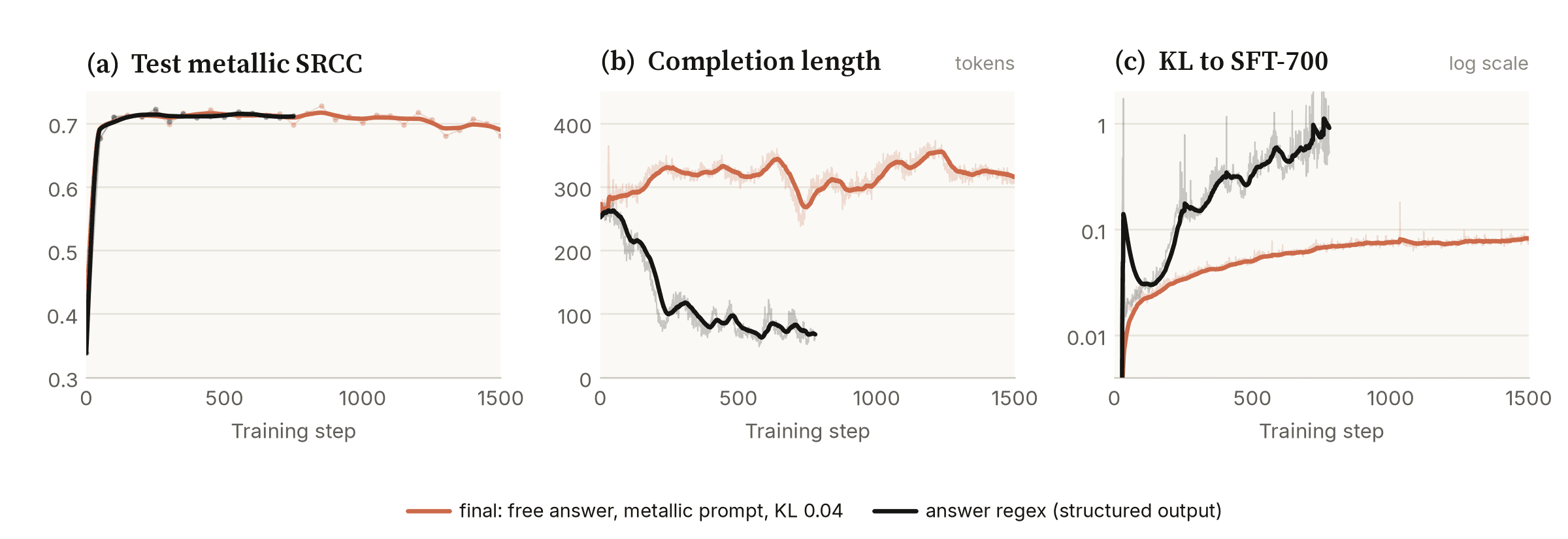
- 不要强制答案格式。用正则强制答案格式后,金属度 SRCC 仍在 0.71 左右,但 reasoning 被毁了:从约 260 个 token 缩到 70 个,模型也偏离了 SFT(最后 20 步对 SFT 的 KL 平均为 0.76,是自由作答版本同一阶段(0.07)的 11 倍)。原因是 vLLM 的一个细节:被强制的 token 在采样时看起来是确定的,在训练时却不是,于是训练不再从这些 token 学习。
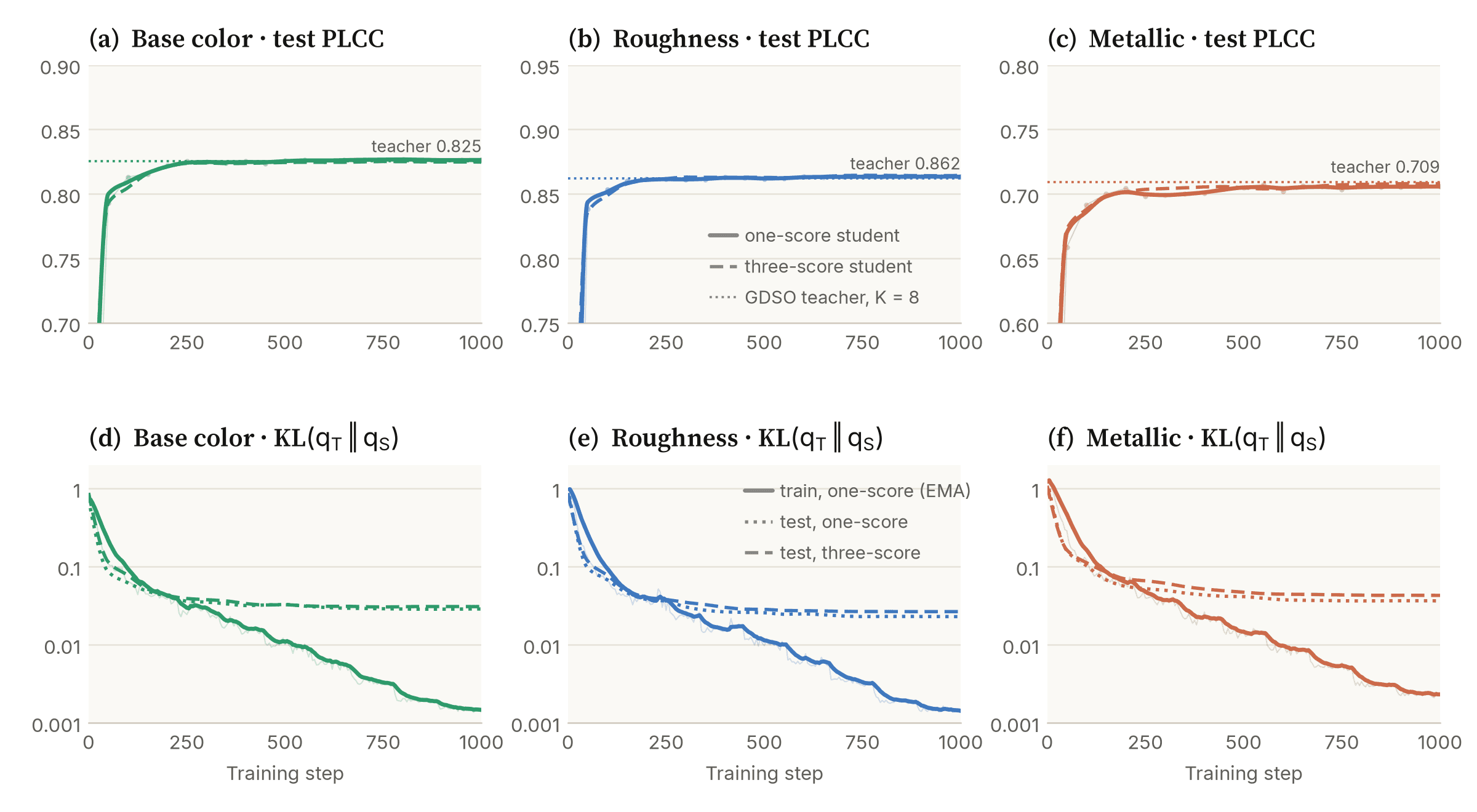
- 9B 学生模型紧紧跟住了教师。每个单项学生最终的 PLCC 与教师相差不到 0.004,给测试资产排的顺序也几乎一样(等级相关 0.98–0.99)。大约 400 步之后,训练损失又降了十倍,测试 PLCC 却不再变化:多出来的训练主要是在记忆训练数据。
- 一个 prompt 打三项分,和三个 prompt 一样好。三项学生和三个单项学生效果相同(平均 PLCC 0.799 对 0.798),而且只要一个模型,不用三个。训练前它的起点也更高(0.376 对 0.242)。
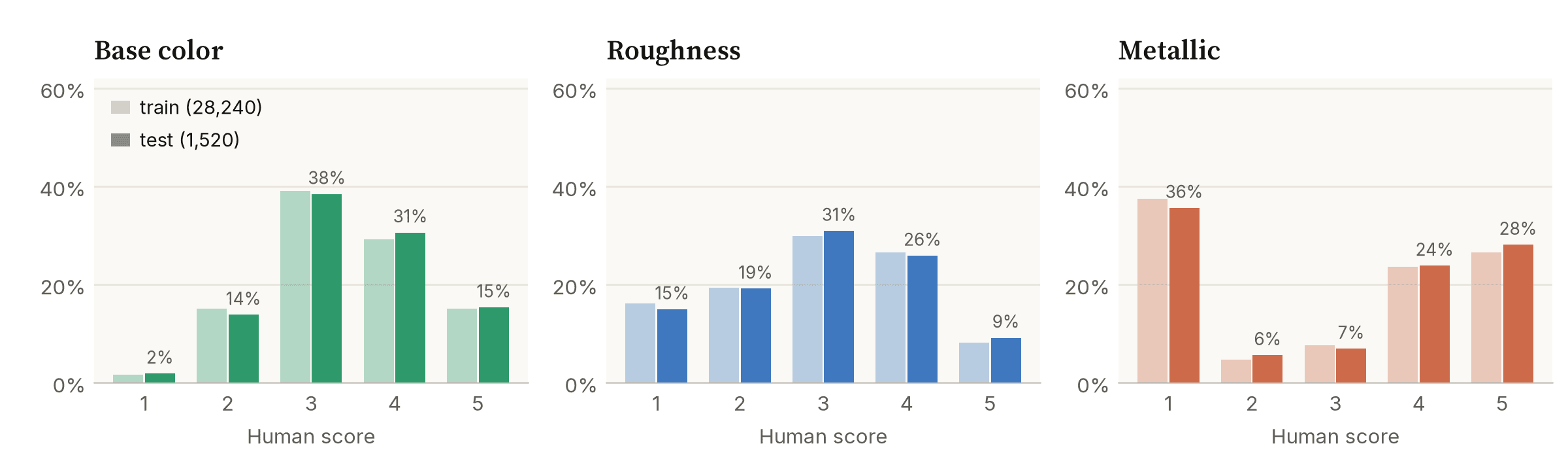
- 金属度在每个阶段都是最难的贴图(教师 PLCC 0.709,81% 的回答在 ±1 分以内)。它的标签集中在 1 分和 5 分,1 分里还包括原始标签 “0”。最大的错误是:人工打 1 分的资产,模型打了 3–5 分。
1流程
每个阶段都从上一阶段的模型出发,只改一件事:模型模仿什么、奖励什么,或者写多长。每个阶段的 prompt 也会变,§3–§5 用灰框列出了每一版。灰框里的 prompt 保留英文原文,因为模型实际读到的就是这些英文。
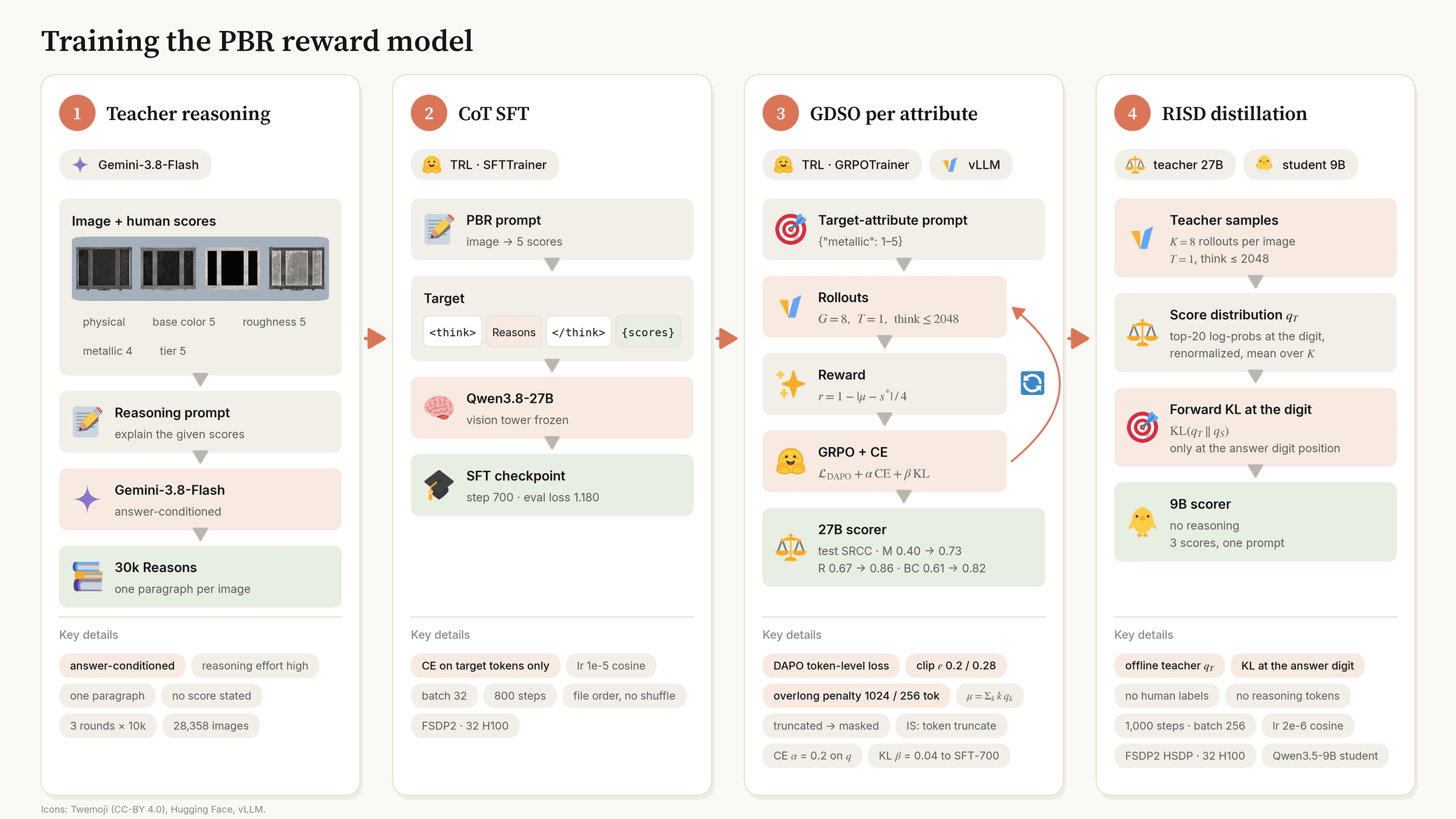
| 阶段 1 · CoT SFT | 阶段 2 · GDSO(每张贴图) | 阶段 3 · RISD | |
|---|---|---|---|
| 模型 | Qwen3.8-27B,冻结视觉编码器 | SFT 第 700 步,冻结视觉编码器 | Qwen3.5-9B;冻结视觉编码器和连接层 |
| 学习目标 | reasons + 五字段 JSON(只在目标 token 上算 CE) | 自由 reasoning + {"metallic": d} | 答案数字处教师对 1–5 的分布 qT;不用人工标签 |
| 损失 | NLL | DAPO token 损失 + 0.2·CE(q, s*) + 0.04·KL(π‖SFT-700);奖励 1 − |μ − s*|/4 + 软超长惩罚(1,024 / 256) | 每个答案数字处的 KL(qT ‖ qS) |
| 数据 | 3 万条 reasons(28,358 张图),按文件顺序 | 金属度 19,062 · 粗糙度 23,002 · 基础色 18,678 条,按文件顺序 | 28,240 条训练数据,每条都有三张贴图的 qT |
| 批大小 × 步数 | 32 × 800(0.9 个 epoch) | 32 张图 × 每张 G = 8 条 rollout × 1,500 步(约过 2.1–2.6 遍数据) | 256 条 × 1,000 步(约 9 个 epoch) |
| 学习率 | 1e-5 cosine,warmup 30 步 | 1e-6 恒定,warmup 3%;clip ε 0.2 / 0.28 | 2e-6 cosine,warmup 30 步 |
| 解码 | 不适用 | T = 1,top-p 1,思考上限 2,048,总长上限 2,112 token;被截断的 rollout 不参与训练 | 不思考(预填 <think>\n\n</think>) |
| 算力 | FSDP2,32 张 H100,1.8 小时 | ZeRO-3 + 与训练同卡的 vLLM(TP 4),64 张 H100,每步约 48–76 秒(金属度前 150 步用 32 张 H100,约 80 秒),共约 20–32 小时 | FSDP2 HSDP,32 张 H100,每步约 9–10 秒,共约 2.6–2.9 小时 |
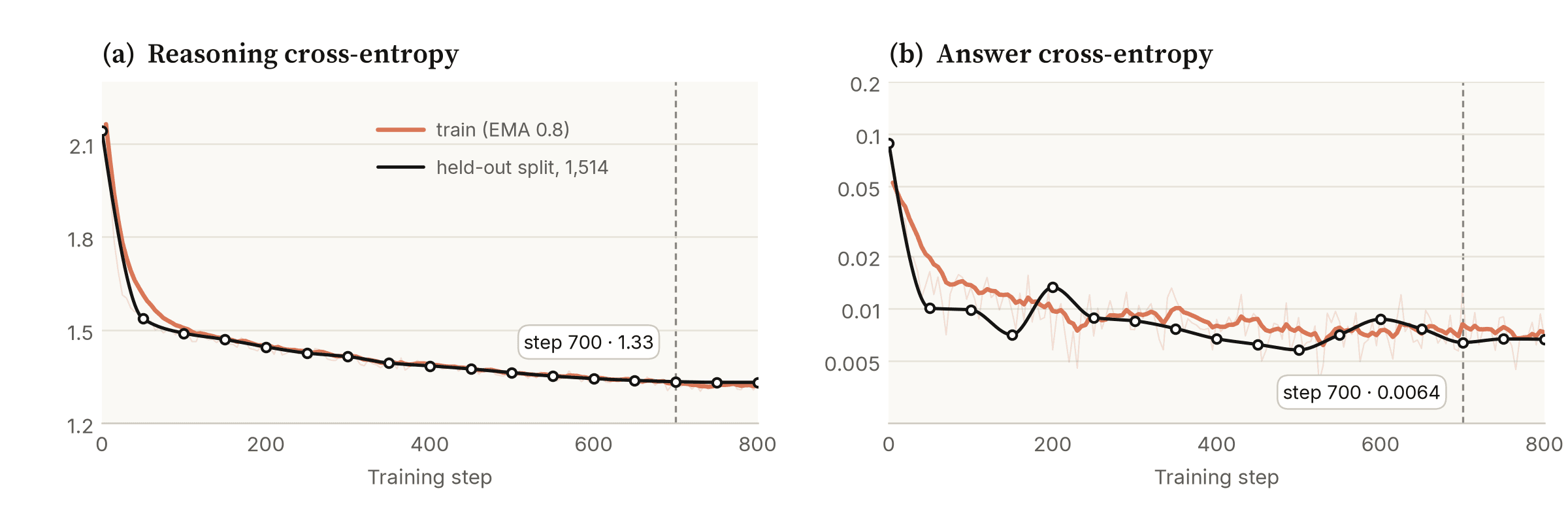
| 选用 | 第 700 步(held-out 损失 1.180) | 测试 SRCC 最高:金属度 850、粗糙度 700、基础色 450 | 报告第 1000 步;按测试 PLCC 保留最好的 4 个 checkpoint |
表 1 训练设置,取自每次训练的配置文件。基础色 GDSO 在第 150 步后因为 GPU 配额减少改用 32 张卡,每步仍是 256 条 rollout。
2数据与评测
标签来自 pbr_reasoning_30k-R1:3 万条人工评分,分三轮,每轮 1 万条,共 28,358 个不同的资产(Tier 1 的资产每轮都有,每次配一段新的解释)。每张图都是同样的 1×4 横条:渲染图、基础色、金属度、粗糙度。所有实验都用同一个固定的测试集,共 1,520 个资产(Tier 1:120 个,Tier 2:500 个,Tier 3–5 各 300 个;87% 是写实风格,11% 是风格化)。GDSO 和 RISD 从不在测试资产上训练。但 1,520 个测试资产中有 1,436 个出现在 SFT 的训练数据里,所以所有 27B 的数字都偏乐观(表 6 中标 †)。9B 学生模型没有见过它们。
我们怎样评测一个模型。每个模型在答案位置都会给出 1–5 分各自的概率,记为 q。对 reasoning 模型,我们从答案 token 的 top-20 log-prob 里读出 q,再对 K 次运行取平均。对学生模型,q 就是一次 softmax 的输出。由 q 算出期望分 μ,再用两种方式和人工评分比较。SRCC(Spearman 等级相关)看 μ 给资产排的先后顺序是否和人工一致;PLCC(Pearson 线性相关)看 μ 是否随人工评分同步升降。奖励模型两者都需要。我们还报告 q 的中位数和人工评分平均差多少分(MAE),以及相差不超过 1 分的比例(±1)。因为奖励直接使用 μ,§7 还测量了 μ 本身离人工评分有多远。GDSO 训练过程中的评测,每张图只运行一次。
3阶段 1:SFT(CoT Reasoning)
Reasons。Gemini-3.8-Flash 看到每张图和它的人工评分,写一段话解释这些分数,但不复述分数(Prompt 0)。SFT 再教 Qwen3.8-27B 把这样一段话写成自己的思考,最后给出五个分数(Prompt 1)。
<system: the five-field scorer prompt (Prompt A1) through its Scoring rules, plus one rule:>- The reasons cite concrete visual evidence for each score (which region, which panel, which defect or strength); do not paraphrase the rubric.<image>The senior technical artist's ratings:"visual style": "physical", "base color": 3, "roughness": 3, "metallic": 1, "overall tier": 3These ratings are final. Write a long, exhaustive explanation of the reasoning behind them in one paragraph of plain prose, in the order style, base color, roughness, metallic, overall tier, giving each part several sentences. For each channel, address every point of its rubric's Focus line for each distinct part of the asset, citing the panel and region where it is seen and how it shows in the Reference, and say what keeps it from the next level up. Prefer completeness to brevity and write at least 300 words, without headings, lists or scores.Reasons:
Gemini 拿到分数,只需要解释。它的 system prompt 是 SFT prompt(Prompt A1)从开头到评分规则(含)的全部内容,再加上框里这一条规则。凡是写出分数、提到评分或使用列表的段落,都会被丢掉重新生成。这里的评分行只是示例,每个请求带的是自己那个资产的分数。
…Scoring rules:- Scores are integers 1-5. Assign the highest level whose description is substantially met; when torn between two levels, choose the lower.- Score each channel against its own rubric before rating the overall tier.- Every field gets a score: a map that is a flat constant fill is scored by its rubric, not skipped. Output format:Reason first, in your thinking, then answer.1. In your thinking, follow the evaluation procedure: classify the visual style, check the image against the Base Color, Roughness, and Metallic rubrics in turn, then weigh the overall tier. Every conclusion cites evidence visible in the image (which panel, which region or part, the specific defect or strength); do not paraphrase the rubric.2. Do not write any score or tier number in your thinking; close each field with its main strengths and problems.3. Keep your thinking under 600 words.4. After your thinking, output exactly one line, a JSON object with exactly these keys in this order, and nothing after it:{"visual style": "<physical|stylized|uncertain|others>", "base color": <1-5>, "roughness": <1-5>, "metallic": <1-5>, "overall tier": <1-5>}<|im_end|><|im_start|>userEvaluate the PBR texture set shown in this image.<|vision_start|><|image_pad|><|vision_end|><|im_end|><|im_start|>assistant<think>
高亮部分:输出格式。思考不超过 600 词,然后输出一行 JSON,包括风格、三张贴图的分数和总体等级。完整 prompt 见附录。
4阶段 2:GDSO 教师模型
GDSO 就是 GRPO(一种强化学习方法:对同一张图生成 8 个回答(rollout),让它们互相比较来打分),只是奖励看的是整个分数分布。在答案位置,我们读出 q,也就是模型给 1–5 分各自的概率,再用 1 − |μ − s*|/4 奖励这条 rollout,其中 μ 是期望分,s* 是人工评分。另外还有三项辅助:一个把 q 拉向人工评分的交叉熵(权重 0.2);一个 KL 惩罚,它衡量模型输出离 SFT-700 有多远,让模型别偏太远(权重 0.04);以及 DAPO 的超长惩罚:rollout 超过 768 个 token 就扣分。每张贴图单独训练,各用自己的 prompt:把 SFT prompt 删到只剩一套 rubric,答案也只有一个键(Prompt 2)。
<|im_start|>systemYou are a senior technical artist and PBR material reviewer with expertise in physically based rendering (PBR) and material reflectance analysis. Your task is to evaluate the Metallic map of a 3D asset's PBR texture set and rate its quality for physically plausible, style-consistent rendering. Input:You receive one image: a 1x4 grid of four panels of the same asset, left to right: Reference (a render of the textured asset), Base Color, Metallic, Roughness. Evaluation procedure:1. Analyze the asset's part structure and material composition from the Reference and Base Color panels, and judge its visual style.2. For each visible region, infer its material class and whether its visible surface is bare metal.3. Compare the Metallic map with that expectation, with the metal response in the Reference, and with the checks, then score it with the Metallic rubric. Style-aware evaluation:- Realism-driven assets: physical correctness is the primary criterion; real-world metal priors apply in full.- Stylized assets (cartoon, anime, hand-painted, cel-shaded): reduced metallic contrast and simplified, stable metal regions are correct when deliberate and consistent; high-frequency metallic noise or realistic metal reflections that fight the look are defects.- Mixed or unclear styles: favor stable, coherent readings; apply physical priors where a region's material is clear.- All styles: technical defects are always penalized. Material reasoning:- Judge the map by the intrinsic material a region represents, not by how the region looks in the image.- Infer the most likely material class per region: bare metal, painted/coated metal, oxidized metal, plastic, rubber, ceramic, glass, stone, concrete, wood, fabric, leather, or composite.- Painted, coated, oxidized, rusty, or dusty surfaces behave as dielectric at the visible surface; only exposed bare metal is metallic.- Hard-surface or mechanical appearance does not imply metal; dark or glossy-looking regions are not metal by default.- Worn edges, handles, and contact areas may expose bare metal under a coating; such details count only if physically plausible and stylistically consistent. Reference material priors:- Bare conductive metals (steel, aluminum, chrome, gold, copper): metallic near 1.- Painted, coated, oxidized, or rusty metal: metallic near 0 at the surface.- Plastic, rubber, wood, fabric, leather, stone, concrete, ceramic, glass: metallic 0.- Stylized assets: reduced metallic contrast is expected. Checks:- The map must be intrinsic: illumination, shadows, highlights, or reflections baked into it are defects.- Cross-channel consistency: a metal region has a metal-like base color, and the Reference shows it as metal.- Noise is not detail: variation must follow the material and its surface history, not random speckle.- Penalize technical defects in every style: blur, seams, misalignment with part boundaries, compression artifacts, placeholder fills. Metallic rubric:Focus: Sparsity and semantic correctness of metal regions, binary values, boundary crispness and alignment, mid-gray areas and noise, physical logic of rust/dirt/paint/wear, metal response in the Reference.- 5: Sparse, semantically meaningful, and essentially binary: bare metal at 1, all dielectrics (including paint, rust, and grime) at 0, no ambiguous mid-gray zones; crisp boundaries aligned with part edges; chipped edges exposing bare metal switch to metal with physical logic. The Reference shows convincing metals with correct, base-color-tinted reflections and sheen.- 4: Metal/non-metal assignment is logically correct and matches the object's material makeup; gloss and reflections look realistic. Fine detail is generalized: micro transitions, chipped-coating edges, and mixed-metal surfaces are simplified. Stable metal read with minor gaps.- 3: Metal regions are assigned correctly, but metals lack reflective punch and the characteristic visual intensity of metal (e.g., values well below 1, dull metal base color); edge and wear breakup is overly simple; slight speckle, noise, or compression artifacts in places. Correct but cheap, just passing.- 2: Metal areas are vague, with soft, poorly defined boundaries, broad intermediate grays, or noisy speckling; metalness partly follows image brightness or highlights rather than material; reflections look dull and weak. Metal is barely recognizable and the segmentation is too abstract.- 1: Violates PBR fundamentals: metal/non-metal assignment is wrong or inverted (e.g., cloth, wood, or painted parts marked metal; bare steel at 0; a whole hard-surface model set metallic because it looks mechanical), or large unjustified gray / light-gray-white areas; values are disconnected from the materials and cannot support even a basic metal definition.- Note: An all-dielectric asset with a clean, uniform 0 map is correct and can score 5; do not penalize it for lacking metal detail. An all-0 map is wrong only when the Base Color or the Reference shows bare metal. Scoring rules:- The score is an integer 1-5. Assign the highest level whose description is substantially met; when torn between two levels, choose the lower.- A map that is a flat constant fill is scored by the rubric, not skipped. Output format:Reason first, in your thinking, then answer.1. In your thinking, follow the evaluation procedure for the Metallic map. Every conclusion cites evidence visible in the image (which panel, which region or part, the specific defect or strength); do not paraphrase the rubric.2. Do not write the score in your thinking; close with the map's main strengths and problems.3. Keep your thinking under 400 words.4. After your thinking, output exactly one line, a JSON object with exactly this key, and nothing after it:{"metallic": <1-5>}<|im_end|><|im_start|>userEvaluate the Metallic map of the PBR texture set shown in this image.<|vision_start|><|image_pad|><|vision_end|><|im_end|><|im_start|>assistant<think>
高亮部分:逐行对比后,SFT prompt 里没有的每一行。新增的有:角色说明、评测步骤、风格部分、检查项、评分规则和输出格式;material reasoning 部分有四行改成了专门针对金属。金属度 rubric 本身没有变。风格分类和另外两套 rubric 被删掉了。模型在不超过 400 词的思考之后,以普通文字写出答案 {"metallic": <1-5>},没有任何机制强制这个格式。粗糙度和基础色的 prompt 也是同样的改法(见附录)。
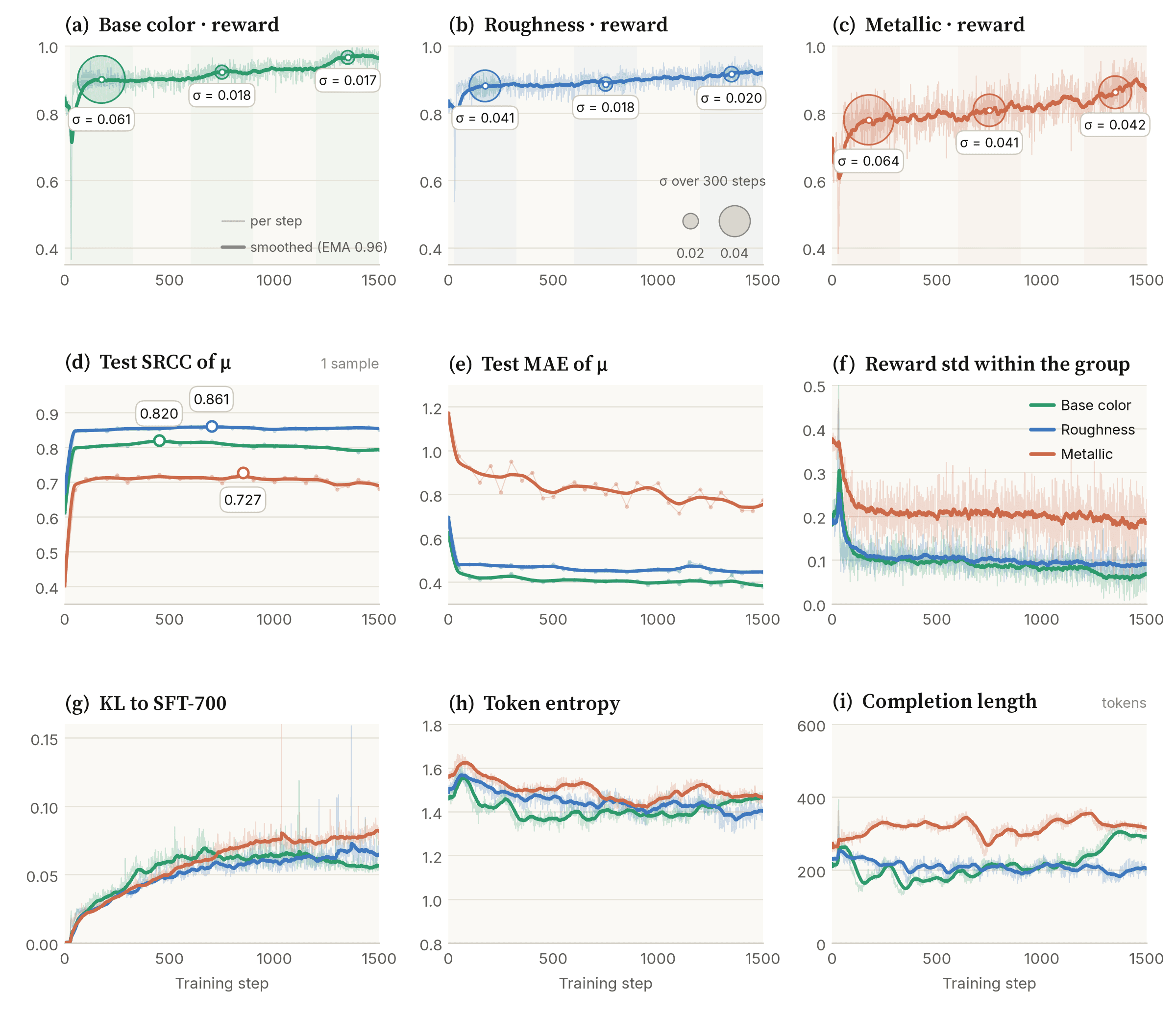
| 贴图 | SFT-700 | 第 50 步 | 最佳 | 第 1500 步 | μ 的 MAE | μ 离散度 | 格式 |
|---|---|---|---|---|---|---|---|
| 基础色 | 0.611 | 0.797 | 0.820 @450 | 0.794 | 0.400 | 0.83 | 99.9% |
| 粗糙度 | 0.667 | 0.846 | 0.861 @700 | 0.851 | 0.447 | 0.84 | 99.9% |
| 金属度 | 0.401 | 0.678 | 0.727 @850 | 0.681 | 0.745 | 0.79 | 99.9% |
表 2 每张贴图都在第 450 到 850 步之间达到最佳。每个资产运行一次时 μ 的测试 SRCC。MAE 和 μ 离散度取自最佳的那一步,此时两两比较的准确率是 0.910 / 0.913 / 0.853。μ 离散度是 μ 的标准差除以人工评分的标准差。“格式” 是格式正确的回答占比。训练开始后,光是采样噪声就会让一次评测上下浮动约 ±0.02;第 0 步时最多 ±0.05。SFT-700 一列是 GDSO 自己第 0 步的评测;图 5 中的单次运行数值(0.640 / 0.674 / 0.370)是同一个模型的另一次采样,两者的差距就是这种噪声。
分数不仅更准,而且更稳定
单次运行的 q 取决于模型这一次碰巧采样出的 reasoning。把 K 次运行的 q 取平均,可以把两件事分开:模型的分数有多稳定,以及它的平均判断有多好。图 5 对 SFT-700 和三个教师模型做了这个分析,每个测试资产运行 8 次。
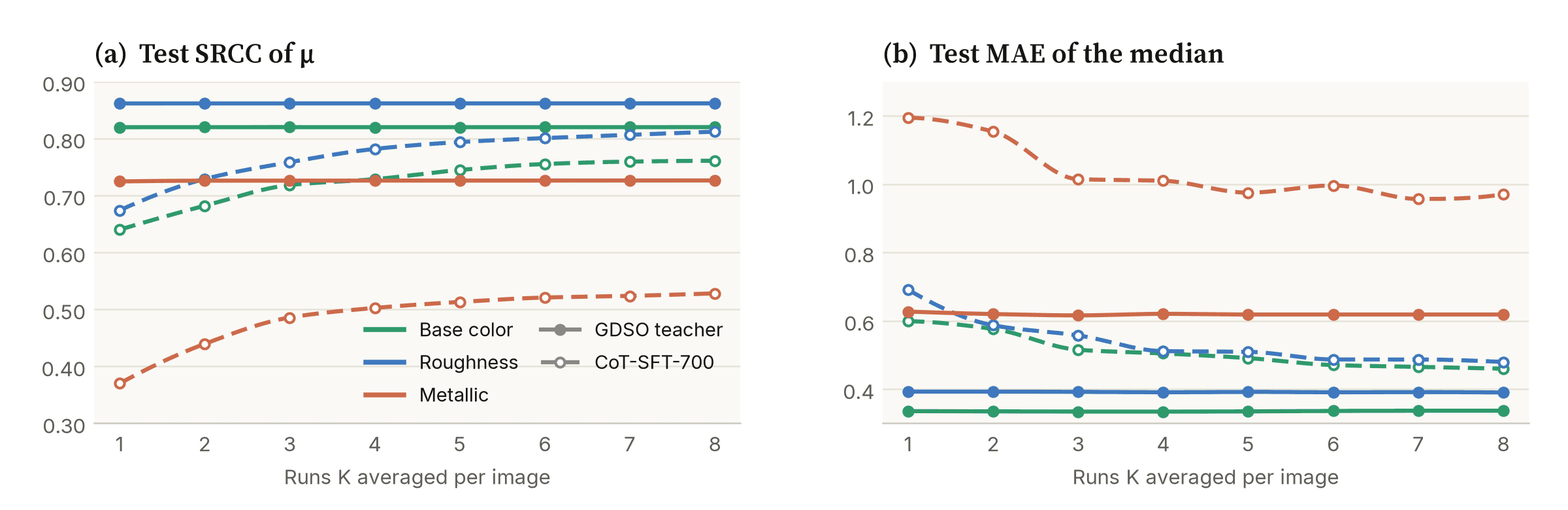
所以,GDSO 在单次运行上的提升,大部分来自稳定性:单次运行时 SRCC 提高 +0.18 到 +0.35,但两个模型都取 8 次平均时,基础色和粗糙度只提高 +0.05 到 +0.06。金属度不一样:即使取 8 次平均,也还有 +0.20 的提升,因为 SFT 对金属度的判断本身就弱。对奖励模型来说,稳定才是关键,因为每张生成的贴图只会被打一次分。
这套方法缺了哪一步不行
我们提前停掉了四个金属度的变体,在这里和最终方案(自由作答、只含金属度的 prompt、KL 0.04)对比。在对 GDSO 本身的改动里,正则的伤害最大:SRCC 没受影响,reasoning 却崩塌了。跳过 SFT 更糟:模型几乎给不出有效答案。五字段 prompt 落后 0.02,而且跑得更慢。
| 金属度训练(除注明外都从 SFT-700 开始) | 第 0 步 | 第 50 步 | 第 100 步 | 观察 |
|---|---|---|---|---|
| 最终方案:自由作答、金属度 prompt、KL 0.04 | 0.401 | 0.678 | 0.710 | 第 850 步最佳 0.727;reasoning 始终约 300 token |
| 答案正则(结构化输出) | 0.338 | 0.676 | 0.710 | reasoning 260 → 68 token,熵 1.56 → 0.93,最后 20 步 KL 0.76(到第 778 步) |
| 五字段 SFT prompt,只奖励金属度 | 0.425 | 0.675 | 0.690 | 第 100 步落后 0.02;rollout 约 425 token,同样 32 张卡上每步约 100 秒,最终方案是 80 秒 |
| 不加 KL 项 | 0.389 | 0.697 | — | 熵一直上升(50 步内 1.56 → 1.67);此后 KL 0.04 成为默认设置 |
| 从未训练的 Qwen3.8-27B 开始(不做 SFT) | 第 0 步格式正确率 6.6% | 在 </think> 之后写了一段文字,而不是那一行 JSON;奖励约 0.06 | ||
表 3 每个变体的金属度测试 SRCC,每个资产运行一次。第 0 步的数值因为采样噪声而不同(最多 ±0.05);除最后一行外,所有训练都从同一个 SFT-700 权重开始。
教师模型怎么说
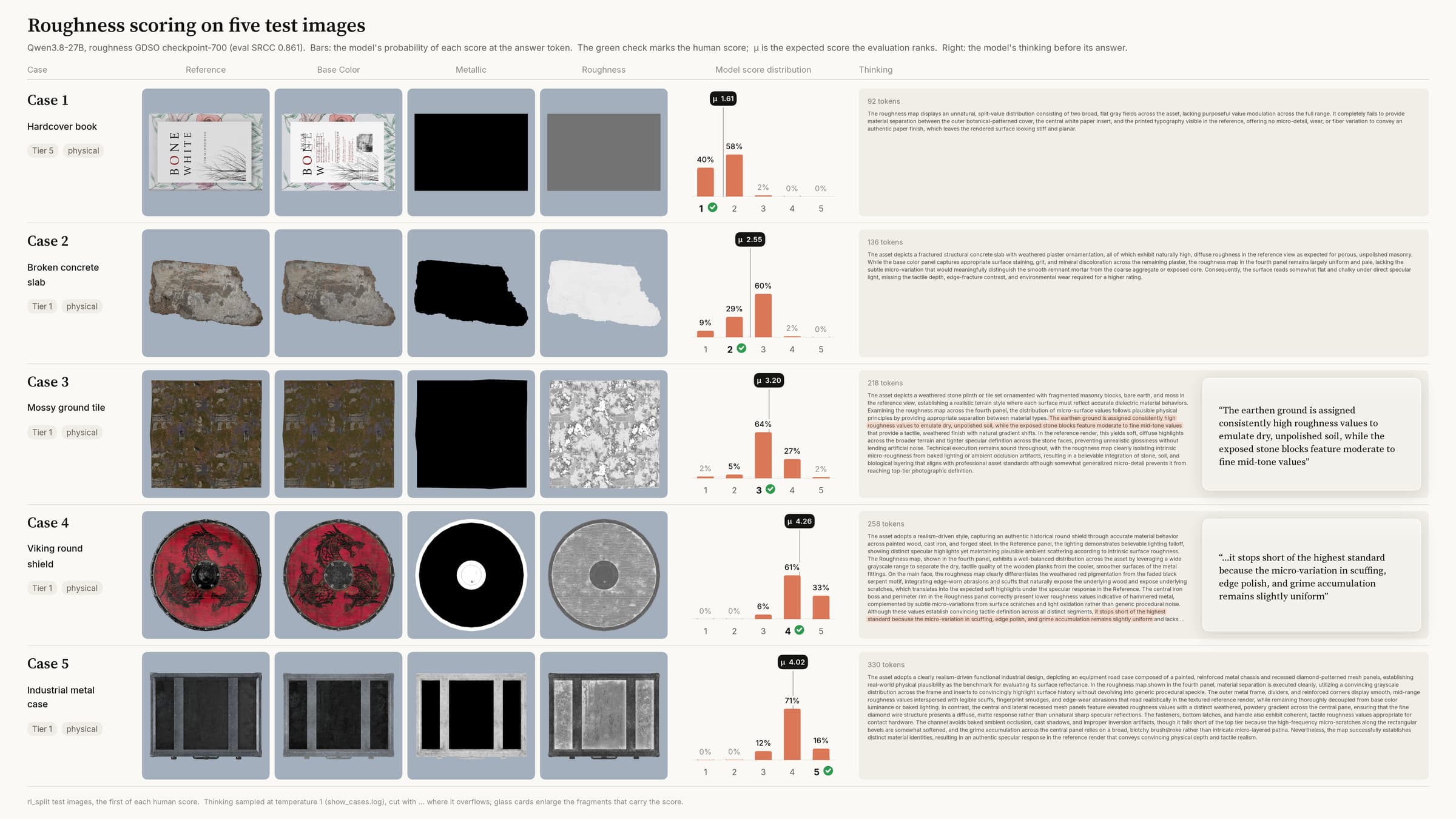
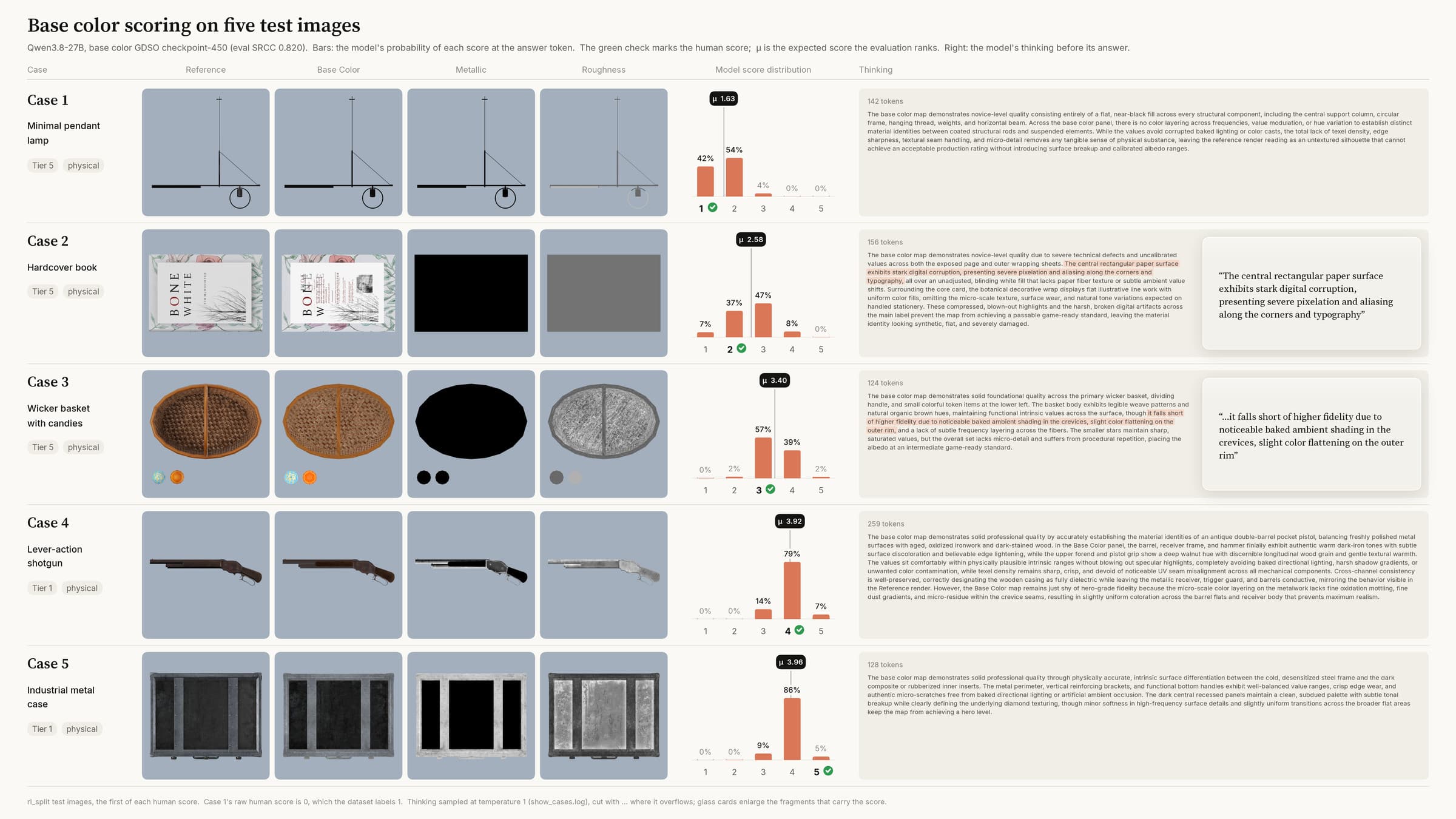
每张贴图选 5 个测试资产,每个人工分数各一个,采样方式和训练时完全相同。柱子是教师模型的 q,对勾标出人工评分。
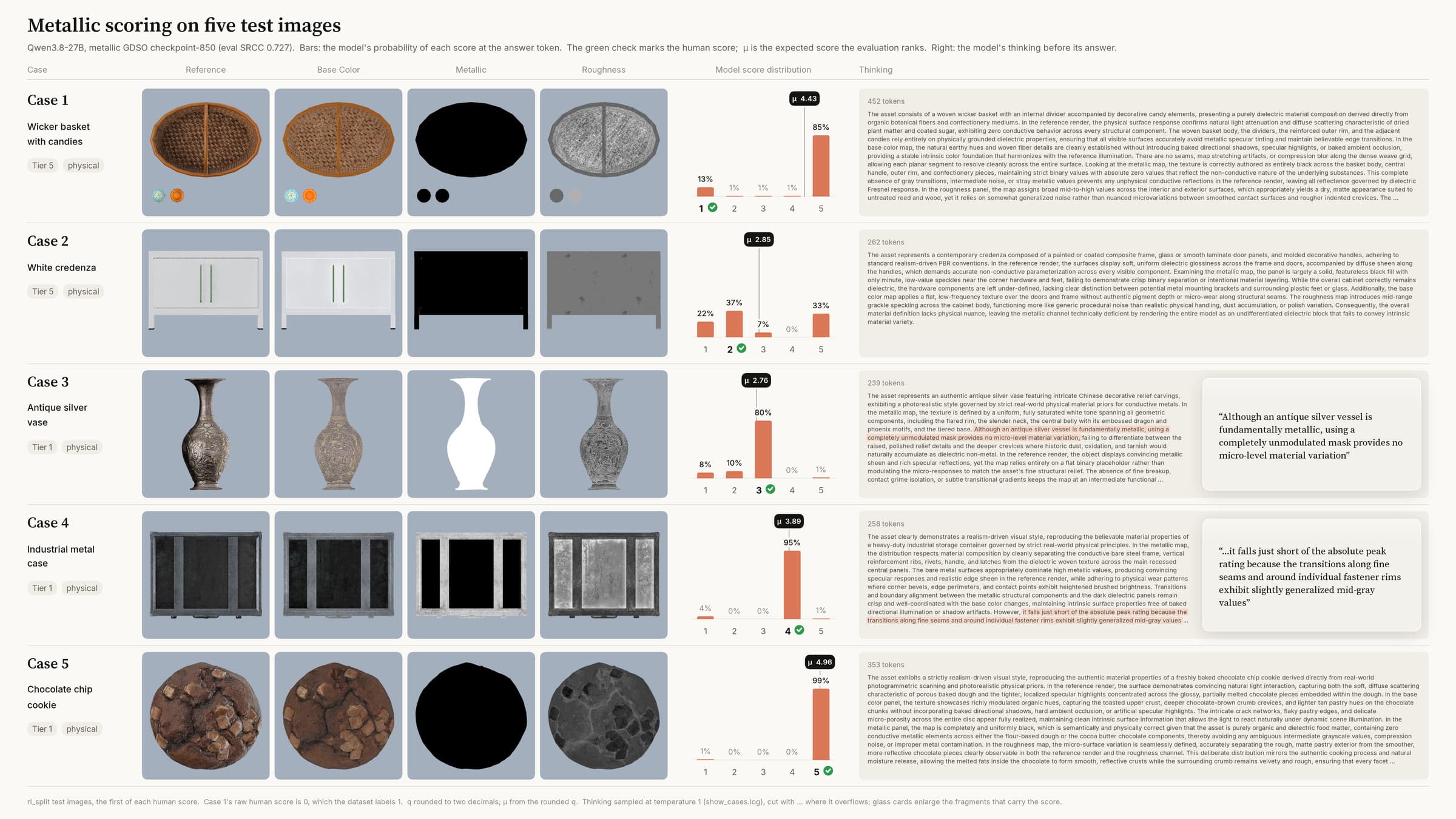
rl_split 指测试集。)表 5 列出了每个案例里教师 8 次平均的 μ 和学生的分数。粗糙度和基础色的案例
5阶段 3:RISD 蒸馏
第 1 步:记录教师模型。每个 GDSO 教师用训练时的设置,在全部 29,760 条数据(训练集和测试集)上各运行 8 次。每次运行取答案数字处的 top-20 log-prob,在 1–5 上重新归一化,再把 8 次平均成 qT。有效运行少于 4 次的数据会被丢掉;测试集一条都没丢。图 5 说明,其实运行一次就够了。第 2 步:训练学生模型。Qwen3.5-9B 拿到的是教师的 prompt,但去掉了评测步骤,答案改成一个数字;它的思考部分留空,所以第一个输出就是这个数字(Prompt 3)。它只学习在这个数字位置上匹配 qT(KL 损失),不用任何人工标签。结果:每个单项学生最终的 PLCC 与教师相差不到 0.004;三项学生同时给三张贴图打分,也做到了同样的水平。
…Scoring rules:- The score is an integer 1-5. Assign the highest level whose description is substantially met; when torn between two levels, choose the lower.- A map that is a flat constant fill is scored by the rubric, not skipped. Output format:Output only one integer from 1 to 5, and nothing else.<|im_end|><|im_start|>userEvaluate the Metallic map of the PBR texture set shown in this image.<|vision_start|><|image_pad|><|vision_end|><|im_end|><|im_start|>assistant<think> </think>
高亮部分:教师 prompt(Prompt 2)里没有的行,只有输出格式和结尾的 </think>。system prompt 的其余部分和教师一样,只是去掉了评测步骤。空的 <think> 块(Qwen 的不思考模板)让答案紧跟在 prompt 后面,所以学生在 prompt 最后一个 token 处的预测就是 qS。
一个 prompt,三个分数。实际使用时,我们不希望每个资产要跑三个 prompt。三项学生拿到一个包含三套 rubric 的 prompt(Prompt 4),回答 “b r m”。训练时,前两个数字填入教师模型最可能给的分数,并在三个数字处各算一次损失(见下方)。测试时,这些数字由学生自己填。
…Scoring rules:- Scores are integers 1-5. Assign the highest level whose description is substantially met; when torn between two levels, choose the lower.- Score each map against its own rubric.- Every map gets a score: a map that is a flat constant fill is scored by its rubric, not skipped. Output format:Output only three integers from 1 to 5, separated by single spaces: the Base Color, Roughness, and Metallic scores, in that order. Output nothing else.<|im_end|><|im_start|>userEvaluate the PBR texture set shown in this image.<|vision_start|><|image_pad|><|vision_end|><|im_end|><|im_start|>assistant<think> </think>
高亮部分:SFT prompt(Prompt A1)里没有的行,即两条评分规则和输出格式。在显示部分之前,风格、材质、检查项和 rubric 都和 SFT prompt 一样;总体等级的 rubric、评测步骤和 JSON 格式被删掉了。
损失是这三个位置上 KL 的平均。prompt 的最后一个 token 预测基础色的数字,每个空格预测下一个数字。训练时填回去的是教师模型最可能给的分数(这里是 4 和 1);测试时填的是学生自己的输出。
| 学生 | 第 0 步 | 第 100 步 | 最佳 | 第 1000 步 | 教师 | 与教师的 SRCC | |Δμ| |
|---|---|---|---|---|---|---|---|
| 基础色 | 0.429 | 0.813 | 0.827 @800 | 0.826 | 0.825 | 0.984 | 0.088 |
| 粗糙度 | 0.090 | 0.853 | 0.864 @600 | 0.863 | 0.862 | 0.991 | 0.084 |
| 金属度 | 0.205 | 0.692 | 0.707 @550 | 0.706 | 0.709 | 0.978 | 0.156 |
| 三项学生,平均 | 0.376 | 0.785 | 0.799 @750 | 0.799 | 0.799 | 0.983 | 0.118 |
| 联合训练,三个 prompt | 0.243 | 0.777 | — | — | 0.799 | 0.964 @100 | 0.197 |
| 金属度,128 × 500 | 0.205 | 0.693 | 0.704 @350 | — | 0.709 | 0.975 @350 | 0.174 |
表 4 每个训练完的学生,PLCC 都与教师相差不到 0.004。测试 PLCC。前三行是单项学生。“与教师的 SRCC” 表示学生和教师给测试资产排的顺序有多接近,“|Δμ|” 是两者期望分的平均差距;除注明外都取第 1000 步。“联合训练,三个 prompt” 是用三个单项 prompt 训练的一个学生;为了改用单 prompt 的版本,我们在第 145 步停掉了它。“金属度,128 × 500” 是最初计划的训练配置,在第 391 步停止。每个学生都把 97–100% 的概率放在五个分数 token 上。
学生在每个资产上都和教师一致吗?
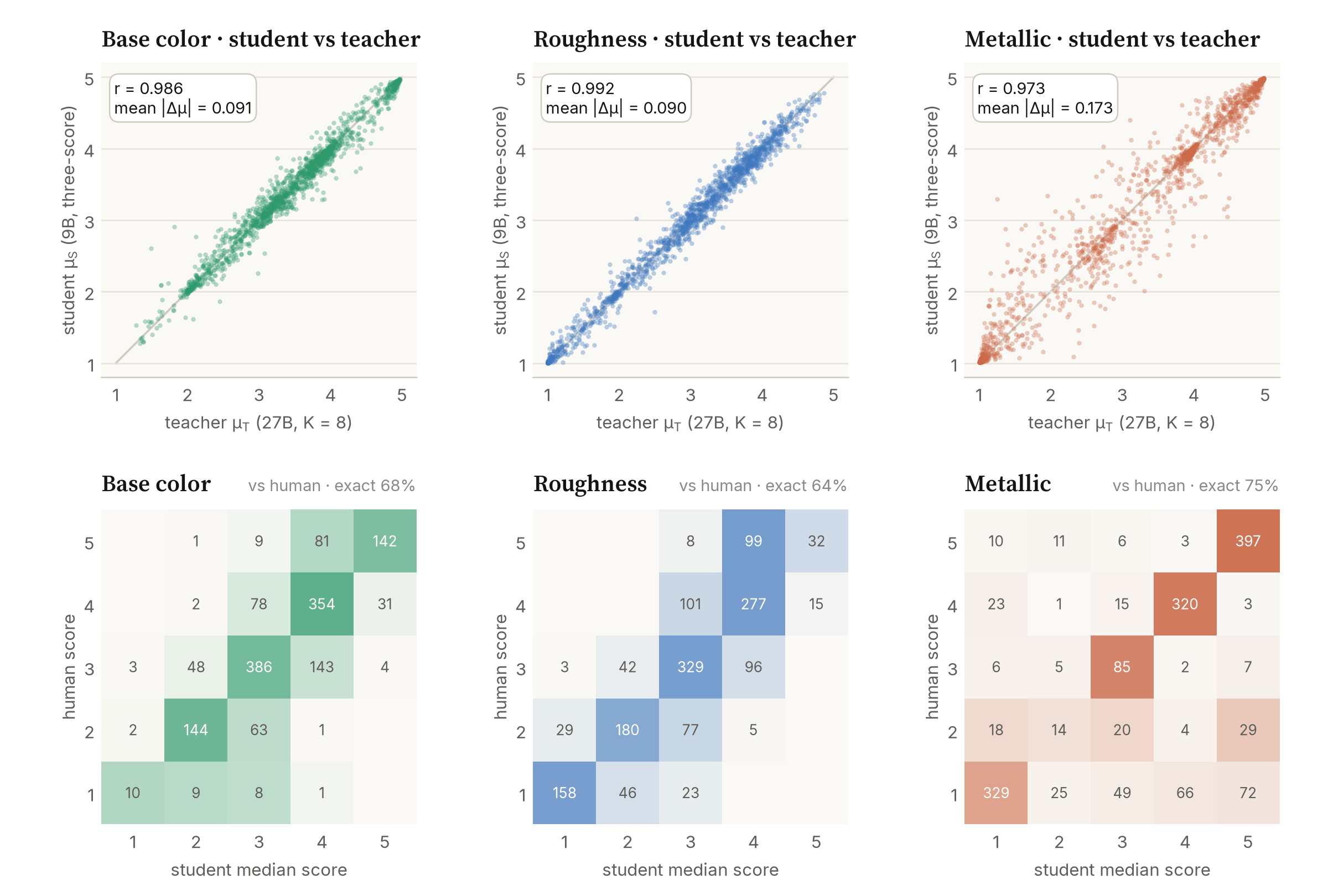
| 贴图 | 案例(图 7) | 人工 | 教师 μT | 学生 μS | 学生中位数 |
|---|---|---|---|---|---|
| 基础色 | 1 · 极简吊灯 | 1 | 1.64 | 1.66 | 2 |
| 2 · 精装书 | 2 | 2.58 | 2.42 | 2 | |
| 3 · 装糖果的藤编篮 | 3 | 3.39 | 3.16 | 3 | |
| 4 · 杠杆式霰弹枪 | 4 | 3.95 | 3.84 | 4 | |
| 5 · 工业金属箱 | 5 | 3.96 | 3.95 | 4 | |
| 粗糙度 | 1 · 精装书 | 1 | 1.53 | 1.23 | 1 |
| 2 · 破碎的混凝土板 | 2 | 2.56 | 2.46 | 3 | |
| 3 · 长苔藓的地砖 | 3 | 3.23 | 3.36 | 3 | |
| 4 · 维京圆盾 | 4 | 4.24 | 4.20 | 4 | |
| 5 · 工业金属箱 | 5 | 4.01 | 4.10 | 4 | |
| 金属度 | 1 · 装糖果的藤编篮 | 1 | 4.45 | 4.36 | 5 |
| 2 · 白色餐边柜 | 2 | 2.86 | 2.75 | 2 | |
| 3 · 古董银花瓶 | 3 | 2.73 | 2.74 | 3 | |
| 4 · 工业金属箱 | 4 | 3.88 | 3.95 | 4 | |
| 5 · 巧克力曲奇 | 5 | 4.97 | 4.97 | 5 |
表 5 图 7 的 15 个案例资产:人工评分、教师 8 次平均的 μ,以及三项学生的 μ 和中位数分(和人工评分一致时加粗)。学生跟着教师走,那个藤编篮(金属度案例 1)也一样:虽然人工评分是 1,两者都把它当作干净的非金属。
6对比(全部模型)
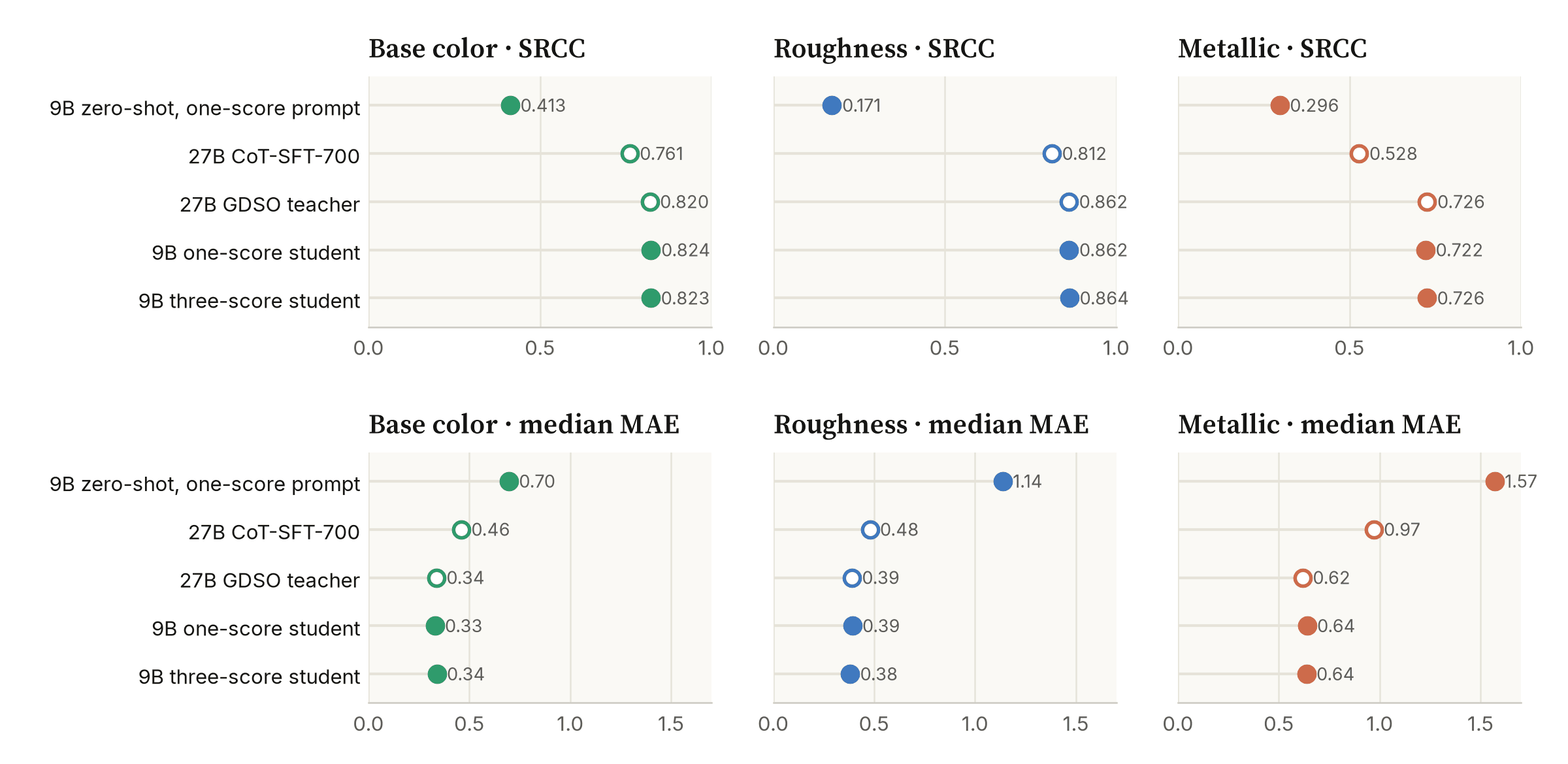
所有模型放在一张表里:同样的 1,520 个资产,同样的 q 读取方式,同样的指标。reasoning 模型取 8 次运行的平均;SFT-700 这一行是我们为这份报告专门跑的,用的是教师模型的采样设置和 prompt。学生模型取第 1000 步(训练结束时)的结果,每个资产只前向一次,不挑最佳 checkpoint。GDSO 教师是在这个测试集上挑出来的,因为我们没有单独的验证集。加粗的是每一列最好的数值。
| 模型 | 基础色 | 粗糙度 | 金属度 | |||||||||
|---|---|---|---|---|---|---|---|---|---|---|---|---|
| PLCC | SRCC | MAE | ±1 | PLCC | SRCC | MAE | ±1 | PLCC | SRCC | MAE | ±1 | |
| 9B zero-shot · 单项 prompt | 0.429 | 0.413 | 0.696 | 91.4% | 0.090 | 0.171 | 1.137 | 70.1% | 0.205 | 0.296 | 1.570 | 54.6% |
| 9B zero-shot · 三项 prompt | 0.481 | 0.476 | 0.670 | 91.9% | 0.376 | 0.386 | 0.924 | 79.4% | 0.272 | 0.306 | 1.355 | 59.7% |
| 27B CoT-SFT-700 · K = 8 † | 0.766 | 0.761 | 0.460 | 96.2% | 0.817 | 0.812 | 0.480 | 96.1% | 0.548 | 0.528 | 0.970 | 71.6% |
| 27B GDSO 教师 · K = 8 † | 0.825 | 0.820 | 0.337 | 98.0% | 0.862 | 0.862 | 0.390 | 97.6% | 0.709 | 0.726 | 0.618 | 81.3% |
| 9B 单项学生(×3) | 0.826 | 0.824 | 0.329 | 98.1% | 0.863 | 0.862 | 0.392 | 97.4% | 0.706 | 0.722 | 0.640 | 81.0% |
| 9B 三项学生 | 0.825 | 0.823 | 0.339 | 98.1% | 0.864 | 0.864 | 0.381 | 97.6% | 0.708 | 0.726 | 0.637 | 80.9% |
| 9B 三项学生,最佳 checkpoint(750) | 0.825 | 0.823 | 0.339 | 98.1% | 0.865 | 0.864 | 0.378 | 97.6% | 0.707 | 0.726 | 0.644 | 80.8% |
表 6 9B 学生在每张贴图上的 PLCC 和 SRCC 都和 27B 教师持平。PLCC 和 SRCC 基于 μ;MAE 和 ±1 准确率基于 q 的中位数。zero-shot 的两行是未训练的 Qwen3.5-9B,分别用单项和三项 prompt。“9B 单项学生(×3)” 一行是三个单项学生的合并结果。† 1,520 个测试资产中有 1,436 个在 SFT 训练数据里,所以 27B 的行偏乐观;9B 的行不受影响。每一行的 Tier 1 召回率和 μ 离散度见 data/unified_test.csv。
7RL 比 SFT 多带来了什么
GDSO 是最贵的一步:每张贴图要在 64 张 GPU 上跑约 20–32 小时。这里我们检验它值不值:在同样的 1,520 个测试资产上,把每个 GDSO 教师和它的起点 SFT-700 checkpoint 做比较。两个模型都是先做 reasoning 再打分,而 reasoning 是采样出来的,所以同一个模型对同一个资产跑两次,可能给出两个不同的分数。我们已经让每个模型在每个资产上跑了 8 次(图 5),所以不用再额外运行模型。我们从三个角度比较这两个模型:
- 单次运行:模型做一次 reasoning,我们只用这一次的回答打分。奖励模型实际就是这样用的。表中的数字是 8 次运行各自单独打分后的平均。
- 8 次运行平均:先把每个资产的 8 个分数分布取平均,再打分。取平均能抵消每次运行之间的噪声,所以这是 SFT 花 8 倍算力能达到的最好结果。
- 两次运行的一致性:用两次独立的运行给同一批资产打分,再用 SRCC 看两组分数有多一致(1 表示两次排的顺序完全相同)。它衡量的是模型的分数是否可复现。
为了区分真正的提升和运气,我们对测试资产做 2,000 次重采样(配对 bootstrap),并给出每项提升的 95% 置信区间。
| 贴图 | 资产 | μ 的 SRCC,单次运行 | μ 的 SRCC,8 次平均 | ||||
|---|---|---|---|---|---|---|---|
| SFT-700 | GDSO | 提升 [95%] | SFT-700 | GDSO | 提升 [95%] | ||
| 基础色 | 全部 1,520 | 0.615 | 0.820 | +0.205 [+0.19, +0.22] | 0.761 | 0.820 | +0.059 [+0.04, +0.07] |
| 未见过 84 | 0.429 | 0.659 | +0.230 [+0.14, +0.32] | 0.589 | 0.657 | +0.068 [−0.02, +0.17] | |
| 粗糙度 | 全部 1,520 | 0.675 | 0.862 | +0.187 [+0.17, +0.20] | 0.812 | 0.862 | +0.049 [+0.04, +0.06] |
| 未见过 84 | 0.383 | 0.553 | +0.170 [+0.05, +0.28] | 0.532 | 0.552 | +0.021 [−0.10, +0.14] | |
| 金属度 | 全部 1,520 | 0.365 | 0.726 | +0.361 [+0.33, +0.39] | 0.528 | 0.726 | +0.199 [+0.17, +0.23] |
| 未见过 84 | 0.327 | 0.791 | +0.464 [+0.37, +0.55] | 0.349 | 0.790 | +0.441 [+0.27, +0.63] | |
表 7 在完整测试集上,每一项提升都远远超出采样噪声。μ 的 SRCC,分单次运行和 8 次平均两种,并给出 GDSO 的提升及其 95% bootstrap 置信区间。单次运行的数值是 8 次单独运行的平均;图 5 只用了第一次运行,所以 SFT 的数字略有不同。灰色的提升表示它的区间包含 0。“未见过” 是 SFT 训练数据里没有的 84 个测试资产。表 8 衡量的是 μ 本身的误差;PLCC,以及中位数的 MAE 和 ±1 准确率,见 data/gdso_vs_sft.csv。
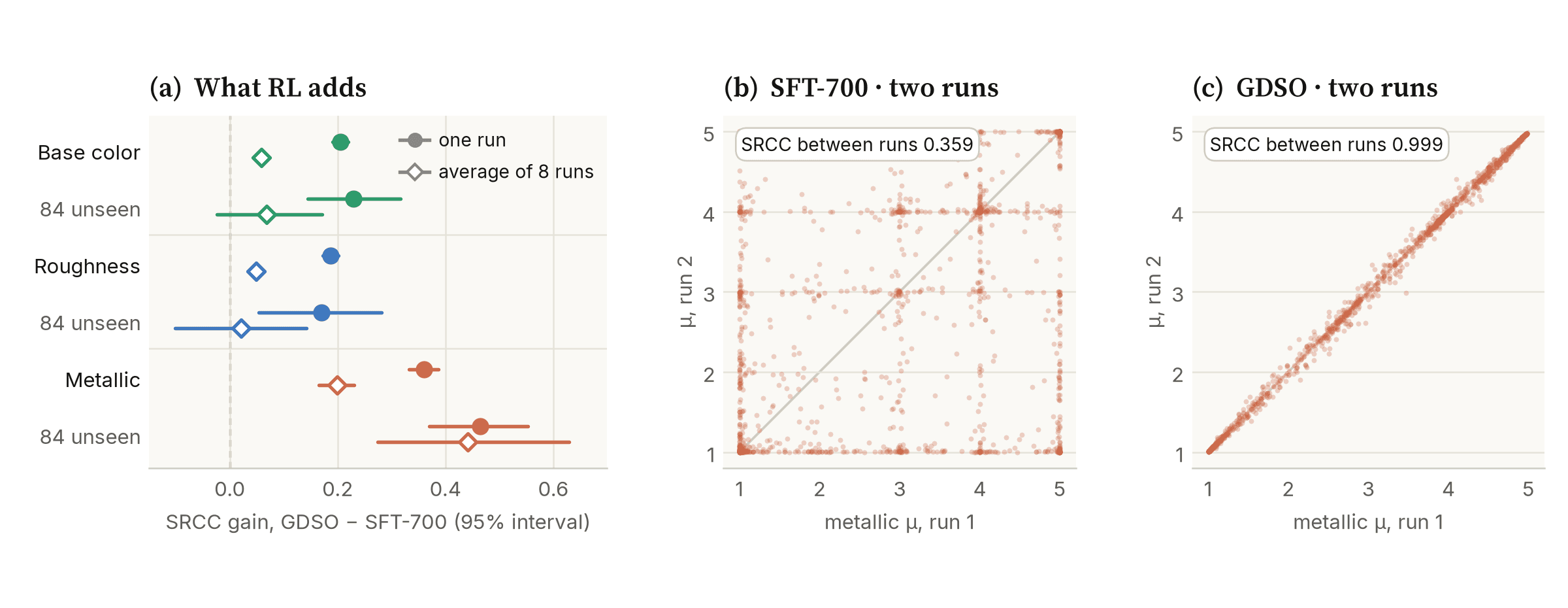
在完整测试集上,结论很明确。只运行一次时,GDSO 把 SRCC 提高了 +0.21(基础色)、+0.19(粗糙度)和 +0.36(金属度)。2,000 次重采样里,没有一次是 SFT 更好。和 SFT 的 8 次平均相比,GDSO 仍然领先 +0.06、+0.05 和 +0.20,而且只需运行一次,因为它单次运行和 8 次平均的 SRCC 是一样的。
在 SFT 没见过的 84 个资产上。这是最干净的检验,因为两个模型都没在这些资产上训练过;但它们数量少,也不太有代表性:其中 66 个是 Tier 1,大多数评分是 4 或 5。即便如此,在每张贴图上,GDSO 运行一次都胜过 SFT 运行一次(SRCC +0.23、+0.17 和 +0.46,区间都在 0 以上)。和 SFT 的 8 次平均相比,金属度的提升仍然很大(+0.44);基础色和粗糙度的提升(+0.07 和 +0.02)太小,资产这么少时无法和噪声区分开。
提升从哪里来。SFT-700 每次运行给出的分数都不一样。对同一个资产,SFT 两次运行相差 1 分或更多的情况,基础色占 27%,粗糙度占 30%,金属度占 42%(图 11 b、c 逐个资产展示了金属度的情况)。经过 GDSO,这种情况几乎不再出现,两次运行给资产排的顺序也几乎完全一致(两次之间的 SRCC 为 0.999–1.000,SFT 只有 0.59、0.64 和 0.36)。所以 RL 做了两件事:一是让分数可复现,这是基础色和粗糙度提升的主要来源;二是让判断本身更准,这是金属度提升的主要来源。奖励模型两者都需要,因为每张生成的贴图只会被打一次分。
期望分本身准不准
奖励直接使用期望分 μ = Σ s·q(s),所以重要的不只是 μ 给资产排的顺序对不对,还有 μ 离人工评分有多近。上面的 SRCC 虽然用的也是 μ,但只检查顺序。表 8 衡量的是距离:μ 的平均绝对误差(μ 的 MAE),以及 GDSO 自己的奖励 1 − |μ − s*|/4,也就是 RL 训练时要提高的那个量。
| 贴图 | 资产 | μ 的 MAE,单次运行 | μ 的 MAE,8 次平均 | 奖励 1 − |μ − s*|/4,单次运行 | |||||
|---|---|---|---|---|---|---|---|---|---|
| SFT-700 | GDSO | 降低 [95%] | SFT-700 | GDSO | 降低 [95%] | SFT-700 | GDSO | ||
| 基础色 | 全部 1,520 | 0.63 | 0.40 | 0.23 [0.22, 0.25] | 0.54 | 0.40 | 0.14 [0.12, 0.16] | 0.842 | 0.900 |
| 未见过 84 | 0.67 | 0.32 | 0.35 [0.29, 0.41] | 0.61 | 0.32 | 0.29 [0.23, 0.36] | 0.833 | 0.921 | |
| 粗糙度 | 全部 1,520 | 0.68 | 0.45 | 0.23 [0.22, 0.25] | 0.54 | 0.45 | 0.09 [0.08, 0.11] | 0.830 | 0.888 |
| 未见过 84 | 0.91 | 0.66 | 0.25 [0.17, 0.33] | 0.79 | 0.66 | 0.12 [0.04, 0.21] | 0.772 | 0.834 | |
| 金属度 | 全部 1,520 | 1.20 | 0.74 | 0.45 [0.41, 0.50] | 1.12 | 0.74 | 0.38 [0.33, 0.42] | 0.701 | 0.814 |
| 未见过 84 | 1.09 | 0.23 | 0.86 [0.71, 1.02] | 1.04 | 0.23 | 0.82 [0.66, 0.98] | 0.727 | 0.943 | |
表 8 只运行一次时,GDSO 的期望分与人工评分的差距在每张贴图上都缩小了约三分之一。μ 的 MAE 是测试资产上 |μ − s*| 的平均值,分单次运行(8 次单独运行的平均)和 8 次平均两种,并给出 GDSO 的误差低了多少,以及 95% bootstrap 置信区间。奖励是 1 − |μ − s*|/4 的平均值,也就是 GDSO 的训练奖励,所以它和 MAE 同步变化。μ 的 RMSE 见 data/gdso_vs_sft.csv。
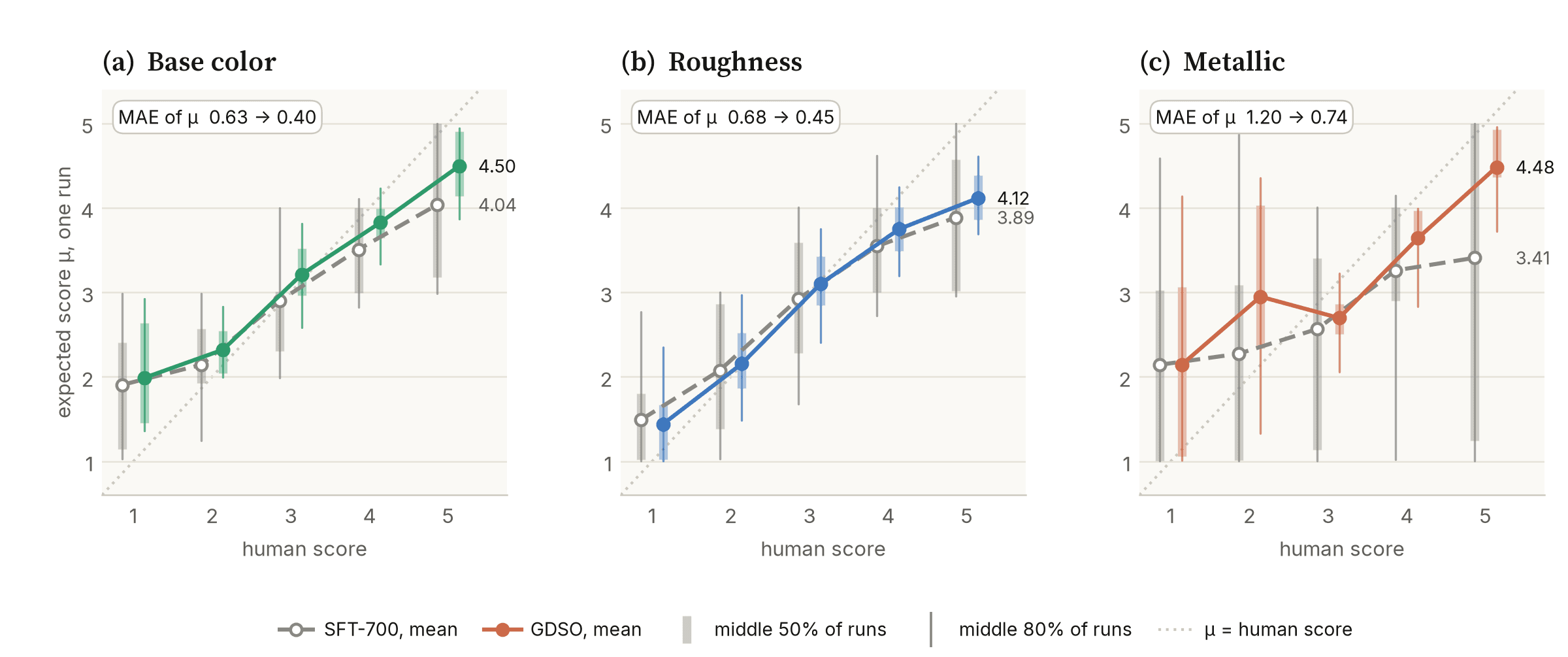
只运行一次时,GDSO 在每张贴图上都把期望分的误差降低了约三分之一:μ 的 MAE 从 0.63 降到 0.40(基础色),从 0.68 降到 0.45(粗糙度),从 1.20 降到 0.74(金属度);奖励从 0.84 升到 0.90、从 0.83 升到 0.89、从 0.70 升到 0.81。SFT 取 8 次平均也补不上这个差距:误差只降到 0.54、0.54 和 1.12,因为 SFT 的期望分被挤向量表中间,取平均纠正不了这一点。人工评分为 5 的资产,SFT 给出的平均 μ 是 4.04、3.89 和 3.41,GDSO 则是 4.50、4.12 和 4.48(图 12)。按这个指标,连那 84 个没见过的资产在每张贴图上也都有明确的提升,不论对比的是 SFT 运行一次还是 8 次平均。人工评分为 1 的金属度资产,仍然是两个模型共同的弱点(平均 μ 为 2.14)。
APrompt 与复现
完整 prompt · CoT SFT(五个字段)
<|im_start|>systemYou are a senior technical artist and PBR material reviewer with expertise in physically based rendering (PBR), material reflectance analysis, and intrinsic decomposition. Your task is to evaluate the PBR texture set (Base Color, Roughness, Metallic) of a 3D asset and rate its quality for physically plausible, style-consistent rendering. Input:You receive one image: a 1x4 grid of four panels of the same asset, left to right: Reference (a render of the textured asset), Base Color, Metallic, Roughness. Evaluation procedure:1. Analyze the asset's geometry, part structure, surface segmentation, and material composition from the Reference and Base Color panels.2. Classify the visual style. The label sets the reference standard for every score.3. For each visible region, infer its material class and surface finish, and derive the Metallic and Roughness behavior you would expect.4. Compare each map with that expectation, with the other panels, and with the common checks, then score Base Color, Roughness, and Metallic with their rubrics.5. Rate the overall quality tier from the channel results, cross-channel consistency, and the look of the Reference. Visual style classification:Assign exactly one label.- physical: realism-driven, built from real-world reference; follows PBR conventions.- stylized: art-directed (cartoon, anime, hand-painted, cel-shaded); may depart from PBR rules on purpose to achieve its look.- uncertain: mixes realistic and stylized cues, or shows too little to tell them apart.- others: neither realistic nor a recognizable art style. Style-aware evaluation (Harmony First):- physical: physical correctness is the primary criterion; real-world material priors apply in full.- stylized: harmony with the art direction outranks physical accuracy. Simplified, stable reflectance (painted light and shade in the albedo, exaggerated hues, low metallic contrast, high and uniform roughness) is correct when deliberate and consistent, and intentionally flat regions are not defects; realistic reflectance that fights the look (sharp specular, metallic noise, busy roughness variation) is. Read the rubrics' realism and fine-detail criteria as clarity, intentionality, and coherence with the art direction.- uncertain: favor stable, coherent readings; apply physical priors where a region's material is clear, and accept simplifications a stylized reading would allow.- others: judge technical quality and internal consistency only.- All styles: technical defects are always penalized, and local variation must not break the global style. Material reasoning:- Judge each map by the intrinsic material a region represents, not by how the region looks in the image.- Infer the most likely material class per region: bare metal, painted/coated metal, oxidized metal, plastic, rubber, ceramic, glass, stone, concrete, wood, fabric, leather, or composite.- Painted, coated, oxidized, rusty, or dusty surfaces behave as dielectric at the visible surface; only exposed bare metal is metallic.- Hard-surface or mechanical appearance does not imply metal; dark or glossy-looking regions are not metal by default.- Roughness encodes micro-surface finish, not brightness or shading; a roughness map that copies base color luminance or lighting is a defect.- Use part semantics to judge wear and grime: edges, handles, and contact areas wear; recesses and crevices collect dirt. Such details count only if physically plausible and stylistically consistent. Reference material priors:- Bare conductive metals (steel, aluminum, chrome, gold, copper): metallic near 1; roughness follows finish (polished low, brushed medium, cast or sandblasted high).- Painted, coated, oxidized, or rusty metal: metallic near 0 at the surface.- Plastic, rubber, wood, fabric, leather, stone, concrete, ceramic, glass: metallic 0.- Roughness is low for glass, polished metal, glossy paint, and glazed ceramic; medium for plastic, leather, and satin paint; high for rubber, fabric, concrete, raw wood, and stone.- Roughness increases with abrasion, oxidation, dust, and stylization level; polished, wet, oily, or frequently handled areas read glossier.- Stylized assets: reduced metallic contrast and elevated roughness are expected. Common checks for all maps:- Maps must be intrinsic: illumination, shadows, AO, highlights, or reflections baked into a map are defects (deliberate painted shading in stylized albedo excepted).- Cross-channel consistency: the same semantic region keeps one material across Base Color, Metallic, and Roughness (e.g., a metal region has a metal-like base color and a roughness that fits its finish).- Noise is not detail: variation must follow the material and its surface history, not random speckle.- Judge effective detail, not nominal resolution: an upscaled or blurry map scores by the detail actually visible.- Penalize technical defects in every style: blur, seams, stretching, visible tiling, compression artifacts, noise, placeholder fills. Base Color rubric:Focus: Color layering across frequencies, material identity, value and exposure range, baked lighting, color casts, texel density and sharpness, tiling, seams.- 5: Hero-quality albedo: rich multi-scale color variation, with crisp high-frequency detail over smooth large-scale gradients; every material (leather, metal, stone, paint) reads as real. Clean and intrinsic: no baked shading, AO, or highlights, no crushed blacks or blown whites, exposure consistent across materials; no unmotivated color casts (green shift, magenta); uniform, very fine texel density with no visible repetition or sharpness loss. ArtStation / AAA hero level.- 4: Professional game albedo: accurate color and clearly identifiable materials, rich detail just short of hero precision; minor local softness, slight hue/value deviation, or faint baked shading; transitions are natural but some areas read flat. Roughly 90% there, lacking the 'wow' factor.- 3: Usable but unpolished: most regions convey their material and overall color is correct, but layered detail and micro-variation are missing; slightly blurry or inconsistent sharpness; noticeable tiling, mild stretching, or visible baked lighting in places; stiff transitions with abrupt color jumps.- 2: Novice-level: thin, flat color with little layering, large areas are near-uniform fills; lacks high-frequency detail; obvious repetition, blur, seams, misalignment, dirty color, or heavy baked lighting; real material properties are hard to identify. Has color but no material sense.- 1: Placeholder or broken: single flat color, plain gray, or at most coarse color blocks separating parts; severe artifacts; hues far from the intended material (e.g., saturated purple, neon green) not justified by the art style; conveys essentially no material. Roughness rubric:Focus: Value range usage, separation between materials, plausibility of the distribution (wear, grime, oil, oxidation), micro-detail vs. noise, independence from base color and lighting, specular response in the Reference.- 5: Purposeful use of the full 0-1 range with clear, physically consistent separation between materials. Variation follows plausible surface history (wear, grime, oil, oxidation; e.g., scuffed or dirty areas rougher, clean or polished areas glossier) with natural edge transitions; layered but low-noise. The Reference makes material type and age/condition clearly legible. AAA level.- 4: Per-surface values match common expectations (e.g., leather vs. metal buckle) and read clearly; good grayscale layering conveys tactile feel. Micro-detail is somewhat plain, lacking fine high-frequency breakup; minor acceptable noise or banding/quantization.- 3: Basically works and base materials are distinguishable, but values are too uniform within regions or vary in an overly regular, procedural pattern without natural randomness; small details are missing or inaccurate. Surfaces look stiff and not quite real.- 2: Large areas are uniformly glossy or uniformly hazy, values are misused, or the map mostly copies base color luminance or baked lighting; surfaces read as cheap plastic or rubber and material character is barely visible.- 1: Flat black or flat white, or filled with values unrelated to the materials; wrong material class (e.g., fabric mirror-glossy, chrome chalky); no meaningful zoning, the map expresses no material. Metallic rubric:Focus: Sparsity and semantic correctness of metal regions, binary values, boundary crispness and alignment, mid-gray areas and noise, physical logic of rust/dirt/paint/wear, metal response in the Reference.- 5: Sparse, semantically meaningful, and essentially binary: bare metal at 1, all dielectrics (including paint, rust, and grime) at 0, no ambiguous mid-gray zones; crisp boundaries aligned with part edges; chipped edges exposing bare metal switch to metal with physical logic. The Reference shows convincing metals with correct, base-color-tinted reflections and sheen.- 4: Metal/non-metal assignment is logically correct and matches the object's material makeup; gloss and reflections look realistic. Fine detail is generalized: micro transitions, chipped-coating edges, and mixed-metal surfaces are simplified. Stable metal read with minor gaps.- 3: Metal regions are assigned correctly, but metals lack reflective punch and the characteristic visual intensity of metal (e.g., values well below 1, dull metal base color); edge and wear breakup is overly simple; slight speckle, noise, or compression artifacts in places. Correct but cheap, just passing.- 2: Metal areas are vague, with soft, poorly defined boundaries, broad intermediate grays, or noisy speckling; metalness partly follows image brightness or highlights rather than material; reflections look dull and weak. Metal is barely recognizable and the segmentation is too abstract.- 1: Violates PBR fundamentals: metal/non-metal assignment is wrong or inverted (e.g., cloth, wood, or painted parts marked metal; bare steel at 0; a whole hard-surface model set metallic because it looks mechanical), or large unjustified gray / light-gray-white areas; values are disconnected from the materials and cannot support even a basic metal definition.- Note: An all-dielectric asset with a clean, uniform 0 map is correct and can score 5; do not penalize it for lacking metal detail. An all-0 map is wrong only when the Base Color or the Reference shows bare metal. Overall quality tier rubric:Focus: Holistic production readiness, cross-channel consistency, style harmony, artifact level, suitable viewing distance.- 5: Cinematic: complete, standards-compliant PBR set with extremely rich, physically correct detail in every channel; channels consistent with each other; no visible compression artifacts. Holds up in close-ups and high-end rendering. Typically >= 4K.- 4: AAA current-gen (PS5): standards-compliant with strong detail; clear roughness and metal separation; well-controlled base color exposure and color; light artistic liberties keep physical plausibility. Typically >= 2K (>= 1K acceptable).- 3: Game-ready (indie / PS4): correct overall and visually satisfying; most regions show legible detail, with only minor fixable defects. Suited to mid-distance views. Realistic >= 1K; stylized 512-1K and crisp.- 2: Mobile: material relationships and structure are correct, without obvious blur or distortion, but detail is sparse. Suited to far views or low-budget projects. Typically 512-1K.- 1: Barely usable: obvious problems (blur, misalignment or stretching, compression artifacts, exposure issues, shaky metal/roughness logic) that need manual repair; broken or placeholder sets also score 1.- Note: Holistic, not an average of the channel scores: it seldom exceeds their mean by more than one level, and one severe defect can pull it lower. Scoring rules:- Scores are integers 1-5. Assign the highest level whose description is substantially met; when torn between two levels, choose the lower.- Score each channel against its own rubric before rating the overall tier.- Every field gets a score: a map that is a flat constant fill is scored by its rubric, not skipped. Output format:Reason first, in your thinking, then answer.1. In your thinking, follow the evaluation procedure: classify the visual style, check the image against the Base Color, Roughness, and Metallic rubrics in turn, then weigh the overall tier. Every conclusion cites evidence visible in the image (which panel, which region or part, the specific defect or strength); do not paraphrase the rubric.2. Do not write any score or tier number in your thinking; close each field with its main strengths and problems.3. Keep your thinking under 600 words.4. After your thinking, output exactly one line, a JSON object with exactly these keys in this order, and nothing after it:{"visual style": "<physical|stylized|uncertain|others>", "base color": <1-5>, "roughness": <1-5>, "metallic": <1-5>, "overall tier": <1-5>}<|im_end|><|im_start|>userEvaluate the PBR texture set shown in this image.<|vision_start|><|image_pad|><|vision_end|><|im_end|><|im_start|>assistant<think>
完整 prompt · GDSO 教师,粗糙度
<|im_start|>systemYou are a senior technical artist and PBR material reviewer with expertise in physically based rendering (PBR) and material reflectance analysis. Your task is to evaluate the Roughness map of a 3D asset's PBR texture set and rate its quality for physically plausible, style-consistent rendering. Input:You receive one image: a 1x4 grid of four panels of the same asset, left to right: Reference (a render of the textured asset), Base Color, Metallic, Roughness. Evaluation procedure:1. Analyze the asset's part structure and material composition from the Reference and Base Color panels, and judge its visual style.2. For each visible region, infer its material class, surface finish, and surface history, and derive the roughness you would expect.3. Compare the Roughness map with that expectation, with the specular response in the Reference, and with the checks, then score it with the Roughness rubric. Style-aware evaluation:- Realism-driven assets: physical correctness is the primary criterion; real-world roughness priors apply in full.- Stylized assets (cartoon, anime, hand-painted, cel-shaded): high, uniform, simplified roughness is correct when deliberate and consistent, and intentionally flat regions are not defects; sharp specular or busy roughness variation that fights the look is a defect.- Mixed or unclear styles: favor stable, coherent readings; apply physical priors where a region's material is clear.- All styles: technical defects are always penalized. Material reasoning:- Judge the map by the intrinsic material a region represents, not by how the region looks in the image.- Infer the most likely material class per region: bare metal, painted/coated metal, oxidized metal, plastic, rubber, ceramic, glass, stone, concrete, wood, fabric, leather, or composite.- Roughness encodes micro-surface finish, not brightness or shading; a roughness map that copies base color luminance or lighting is a defect.- Use part semantics to judge wear and grime: edges, handles, and contact areas wear; recesses and crevices collect dirt. Such details count only if physically plausible and stylistically consistent. Reference material priors:- Roughness is low for glass, polished metal, glossy paint, and glazed ceramic; medium for plastic, leather, and satin paint; high for rubber, fabric, concrete, raw wood, and stone.- Bare metals: roughness follows finish (polished low, brushed medium, cast or sandblasted high).- Roughness increases with abrasion, oxidation, dust, and stylization level; polished, wet, oily, or frequently handled areas read glossier.- Stylized assets: elevated roughness is expected. Checks:- The map must be intrinsic: illumination, shadows, AO, highlights, or reflections baked into it are defects.- Cross-channel consistency: a region's roughness fits the material its Base Color and Metallic show (e.g., a metal region has a roughness that fits its finish), and the Reference's highlights agree with it.- Noise is not detail: variation must follow the material and its surface history, not random speckle.- Judge effective detail, not nominal resolution: an upscaled or blurry map scores by the detail actually visible.- Penalize technical defects in every style: blur, seams, stretching, visible tiling, compression artifacts, placeholder fills. Roughness rubric:Focus: Value range usage, separation between materials, plausibility of the distribution (wear, grime, oil, oxidation), micro-detail vs. noise, independence from base color and lighting, specular response in the Reference.- 5: Purposeful use of the full 0-1 range with clear, physically consistent separation between materials. Variation follows plausible surface history (wear, grime, oil, oxidation; e.g., scuffed or dirty areas rougher, clean or polished areas glossier) with natural edge transitions; layered but low-noise. The Reference makes material type and age/condition clearly legible. AAA level.- 4: Per-surface values match common expectations (e.g., leather vs. metal buckle) and read clearly; good grayscale layering conveys tactile feel. Micro-detail is somewhat plain, lacking fine high-frequency breakup; minor acceptable noise or banding/quantization.- 3: Basically works and base materials are distinguishable, but values are too uniform within regions or vary in an overly regular, procedural pattern without natural randomness; small details are missing or inaccurate. Surfaces look stiff and not quite real.- 2: Large areas are uniformly glossy or uniformly hazy, values are misused, or the map mostly copies base color luminance or baked lighting; surfaces read as cheap plastic or rubber and material character is barely visible.- 1: Flat black or flat white, or filled with values unrelated to the materials; wrong material class (e.g., fabric mirror-glossy, chrome chalky); no meaningful zoning, the map expresses no material. Scoring rules:- The score is an integer 1-5. Assign the highest level whose description is substantially met; when torn between two levels, choose the lower.- A map that is a flat constant fill is scored by the rubric, not skipped. Output format:Reason first, in your thinking, then answer.1. In your thinking, follow the evaluation procedure for the Roughness map. Every conclusion cites evidence visible in the image (which panel, which region or part, the specific defect or strength); do not paraphrase the rubric.2. Do not write the score in your thinking; close with the map's main strengths and problems.3. Keep your thinking under 400 words.4. After your thinking, output exactly one line, a JSON object with exactly this key, and nothing after it:{"roughness": <1-5>}<|im_end|><|im_start|>userEvaluate the Roughness map of the PBR texture set shown in this image.<|vision_start|><|image_pad|><|vision_end|><|im_end|><|im_start|>assistant<think>
完整 prompt · GDSO 教师,基础色
<|im_start|>systemYou are a senior technical artist and PBR material reviewer with expertise in physically based rendering (PBR), material reflectance analysis, and intrinsic decomposition. Your task is to evaluate the Base Color map of a 3D asset's PBR texture set and rate its quality for physically plausible, style-consistent rendering. Input:You receive one image: a 1x4 grid of four panels of the same asset, left to right: Reference (a render of the textured asset), Base Color, Metallic, Roughness. Evaluation procedure:1. Analyze the asset's part structure and material composition from the Reference and Base Color panels, and judge its visual style.2. For each visible region, infer its material class and the albedo you would expect: its color, its value range, and the variation its material and surface history carry.3. Compare the Base Color map with that expectation, with the Reference, and with the checks, then score it with the Base Color rubric. Style-aware evaluation:- Realism-driven assets: physical correctness is the primary criterion; the albedo must be intrinsic, with real-world color and value ranges.- Stylized assets (cartoon, anime, hand-painted, cel-shaded): painted light and shade in the albedo and exaggerated hues are correct when deliberate and consistent, and intentionally flat regions are not defects; read the rubric's realism and fine-detail criteria as clarity, intentionality, and coherence with the art direction.- Mixed or unclear styles: favor stable, coherent readings; apply physical priors where a region's material is clear.- All styles: technical defects are always penalized. Material reasoning:- Judge the map by the intrinsic material a region represents, not by how the region looks in the image.- Infer the most likely material class per region: bare metal, painted/coated metal, oxidized metal, plastic, rubber, ceramic, glass, stone, concrete, wood, fabric, leather, or composite.- The base color is the surface's intrinsic color: illumination, shadows, AO, and highlights belong to the render, not to the albedo.- Use part semantics to judge wear and grime: edges, handles, and contact areas wear; recesses and crevices collect dirt. Such details count only if physically plausible and stylistically consistent. Checks:- The map must be intrinsic: illumination, shadows, AO, highlights, or reflections baked into it are defects (deliberate painted shading in stylized albedo excepted).- Cross-channel consistency: the same semantic region keeps one material across Base Color, Metallic, and Roughness (e.g., a metal region has a metal-like base color).- Noise is not detail: variation must follow the material and its surface history, not random speckle.- Judge effective detail, not nominal resolution: an upscaled or blurry map scores by the detail actually visible.- Penalize technical defects in every style: blur, seams, stretching, visible tiling, compression artifacts, noise, placeholder fills. Base Color rubric:Focus: Color layering across frequencies, material identity, value and exposure range, baked lighting, color casts, texel density and sharpness, tiling, seams.- 5: Hero-quality albedo: rich multi-scale color variation, with crisp high-frequency detail over smooth large-scale gradients; every material (leather, metal, stone, paint) reads as real. Clean and intrinsic: no baked shading, AO, or highlights, no crushed blacks or blown whites, exposure consistent across materials; no unmotivated color casts (green shift, magenta); uniform, very fine texel density with no visible repetition or sharpness loss. ArtStation / AAA hero level.- 4: Professional game albedo: accurate color and clearly identifiable materials, rich detail just short of hero precision; minor local softness, slight hue/value deviation, or faint baked shading; transitions are natural but some areas read flat. Roughly 90% there, lacking the 'wow' factor.- 3: Usable but unpolished: most regions convey their material and overall color is correct, but layered detail and micro-variation are missing; slightly blurry or inconsistent sharpness; noticeable tiling, mild stretching, or visible baked lighting in places; stiff transitions with abrupt color jumps.- 2: Novice-level: thin, flat color with little layering, large areas are near-uniform fills; lacks high-frequency detail; obvious repetition, blur, seams, misalignment, dirty color, or heavy baked lighting; real material properties are hard to identify. Has color but no material sense.- 1: Placeholder or broken: single flat color, plain gray, or at most coarse color blocks separating parts; severe artifacts; hues far from the intended material (e.g., saturated purple, neon green) not justified by the art style; conveys essentially no material. Scoring rules:- The score is an integer 1-5. Assign the highest level whose description is substantially met; when torn between two levels, choose the lower.- A map that is a flat constant fill is scored by the rubric, not skipped. Output format:Reason first, in your thinking, then answer.1. In your thinking, follow the evaluation procedure for the Base Color map. Every conclusion cites evidence visible in the image (which panel, which region or part, the specific defect or strength); do not paraphrase the rubric.2. Do not write the score in your thinking; close with the map's main strengths and problems.3. Keep your thinking under 400 words.4. After your thinking, output exactly one line, a JSON object with exactly this key, and nothing after it:{"base color": <1-5>}<|im_end|><|im_start|>userEvaluate the Base Color map of the PBR texture set shown in this image.<|vision_start|><|image_pad|><|vision_end|><|im_end|><|im_start|>assistant<think>
完整 prompt · RISD 单项学生,金属度
<|im_start|>systemYou are a senior technical artist and PBR material reviewer with expertise in physically based rendering (PBR) and material reflectance analysis. Your task is to evaluate the Metallic map of a 3D asset's PBR texture set and rate its quality for physically plausible, style-consistent rendering. Input:You receive one image: a 1x4 grid of four panels of the same asset, left to right: Reference (a render of the textured asset), Base Color, Metallic, Roughness. Style-aware evaluation:- Realism-driven assets: physical correctness is the primary criterion; real-world metal priors apply in full.- Stylized assets (cartoon, anime, hand-painted, cel-shaded): reduced metallic contrast and simplified, stable metal regions are correct when deliberate and consistent; high-frequency metallic noise or realistic metal reflections that fight the look are defects.- Mixed or unclear styles: favor stable, coherent readings; apply physical priors where a region's material is clear.- All styles: technical defects are always penalized. Material reasoning:- Judge the map by the intrinsic material a region represents, not by how the region looks in the image.- Infer the most likely material class per region: bare metal, painted/coated metal, oxidized metal, plastic, rubber, ceramic, glass, stone, concrete, wood, fabric, leather, or composite.- Painted, coated, oxidized, rusty, or dusty surfaces behave as dielectric at the visible surface; only exposed bare metal is metallic.- Hard-surface or mechanical appearance does not imply metal; dark or glossy-looking regions are not metal by default.- Worn edges, handles, and contact areas may expose bare metal under a coating; such details count only if physically plausible and stylistically consistent. Reference material priors:- Bare conductive metals (steel, aluminum, chrome, gold, copper): metallic near 1.- Painted, coated, oxidized, or rusty metal: metallic near 0 at the surface.- Plastic, rubber, wood, fabric, leather, stone, concrete, ceramic, glass: metallic 0.- Stylized assets: reduced metallic contrast is expected. Checks:- The map must be intrinsic: illumination, shadows, highlights, or reflections baked into it are defects.- Cross-channel consistency: a metal region has a metal-like base color, and the Reference shows it as metal.- Noise is not detail: variation must follow the material and its surface history, not random speckle.- Penalize technical defects in every style: blur, seams, misalignment with part boundaries, compression artifacts, placeholder fills. Metallic rubric:Focus: Sparsity and semantic correctness of metal regions, binary values, boundary crispness and alignment, mid-gray areas and noise, physical logic of rust/dirt/paint/wear, metal response in the Reference.- 5: Sparse, semantically meaningful, and essentially binary: bare metal at 1, all dielectrics (including paint, rust, and grime) at 0, no ambiguous mid-gray zones; crisp boundaries aligned with part edges; chipped edges exposing bare metal switch to metal with physical logic. The Reference shows convincing metals with correct, base-color-tinted reflections and sheen.- 4: Metal/non-metal assignment is logically correct and matches the object's material makeup; gloss and reflections look realistic. Fine detail is generalized: micro transitions, chipped-coating edges, and mixed-metal surfaces are simplified. Stable metal read with minor gaps.- 3: Metal regions are assigned correctly, but metals lack reflective punch and the characteristic visual intensity of metal (e.g., values well below 1, dull metal base color); edge and wear breakup is overly simple; slight speckle, noise, or compression artifacts in places. Correct but cheap, just passing.- 2: Metal areas are vague, with soft, poorly defined boundaries, broad intermediate grays, or noisy speckling; metalness partly follows image brightness or highlights rather than material; reflections look dull and weak. Metal is barely recognizable and the segmentation is too abstract.- 1: Violates PBR fundamentals: metal/non-metal assignment is wrong or inverted (e.g., cloth, wood, or painted parts marked metal; bare steel at 0; a whole hard-surface model set metallic because it looks mechanical), or large unjustified gray / light-gray-white areas; values are disconnected from the materials and cannot support even a basic metal definition.- Note: An all-dielectric asset with a clean, uniform 0 map is correct and can score 5; do not penalize it for lacking metal detail. An all-0 map is wrong only when the Base Color or the Reference shows bare metal. Scoring rules:- The score is an integer 1-5. Assign the highest level whose description is substantially met; when torn between two levels, choose the lower.- A map that is a flat constant fill is scored by the rubric, not skipped. Output format:Output only one integer from 1 to 5, and nothing else.<|im_end|><|im_start|>userEvaluate the Metallic map of the PBR texture set shown in this image.<|vision_start|><|image_pad|><|vision_end|><|im_end|><|im_start|>assistant<think> </think>
完整 prompt · RISD 三项学生
<|im_start|>systemYou are a senior technical artist and PBR material reviewer with expertise in physically based rendering (PBR), material reflectance analysis, and intrinsic decomposition. Your task is to evaluate the PBR texture set (Base Color, Roughness, Metallic) of a 3D asset and rate its quality for physically plausible, style-consistent rendering. Input:You receive one image: a 1x4 grid of four panels of the same asset, left to right: Reference (a render of the textured asset), Base Color, Metallic, Roughness. Visual style classification:Assign exactly one label.- physical: realism-driven, built from real-world reference; follows PBR conventions.- stylized: art-directed (cartoon, anime, hand-painted, cel-shaded); may depart from PBR rules on purpose to achieve its look.- uncertain: mixes realistic and stylized cues, or shows too little to tell them apart.- others: neither realistic nor a recognizable art style. Style-aware evaluation (Harmony First):- physical: physical correctness is the primary criterion; real-world material priors apply in full.- stylized: harmony with the art direction outranks physical accuracy. Simplified, stable reflectance (painted light and shade in the albedo, exaggerated hues, low metallic contrast, high and uniform roughness) is correct when deliberate and consistent, and intentionally flat regions are not defects; realistic reflectance that fights the look (sharp specular, metallic noise, busy roughness variation) is. Read the rubrics' realism and fine-detail criteria as clarity, intentionality, and coherence with the art direction.- uncertain: favor stable, coherent readings; apply physical priors where a region's material is clear, and accept simplifications a stylized reading would allow.- others: judge technical quality and internal consistency only.- All styles: technical defects are always penalized, and local variation must not break the global style. Material reasoning:- Judge each map by the intrinsic material a region represents, not by how the region looks in the image.- Infer the most likely material class per region: bare metal, painted/coated metal, oxidized metal, plastic, rubber, ceramic, glass, stone, concrete, wood, fabric, leather, or composite.- Painted, coated, oxidized, rusty, or dusty surfaces behave as dielectric at the visible surface; only exposed bare metal is metallic.- Hard-surface or mechanical appearance does not imply metal; dark or glossy-looking regions are not metal by default.- Roughness encodes micro-surface finish, not brightness or shading; a roughness map that copies base color luminance or lighting is a defect.- Use part semantics to judge wear and grime: edges, handles, and contact areas wear; recesses and crevices collect dirt. Such details count only if physically plausible and stylistically consistent. Reference material priors:- Bare conductive metals (steel, aluminum, chrome, gold, copper): metallic near 1; roughness follows finish (polished low, brushed medium, cast or sandblasted high).- Painted, coated, oxidized, or rusty metal: metallic near 0 at the surface.- Plastic, rubber, wood, fabric, leather, stone, concrete, ceramic, glass: metallic 0.- Roughness is low for glass, polished metal, glossy paint, and glazed ceramic; medium for plastic, leather, and satin paint; high for rubber, fabric, concrete, raw wood, and stone.- Roughness increases with abrasion, oxidation, dust, and stylization level; polished, wet, oily, or frequently handled areas read glossier.- Stylized assets: reduced metallic contrast and elevated roughness are expected. Common checks for all maps:- Maps must be intrinsic: illumination, shadows, AO, highlights, or reflections baked into a map are defects (deliberate painted shading in stylized albedo excepted).- Cross-channel consistency: the same semantic region keeps one material across Base Color, Metallic, and Roughness (e.g., a metal region has a metal-like base color and a roughness that fits its finish).- Noise is not detail: variation must follow the material and its surface history, not random speckle.- Judge effective detail, not nominal resolution: an upscaled or blurry map scores by the detail actually visible.- Penalize technical defects in every style: blur, seams, stretching, visible tiling, compression artifacts, noise, placeholder fills. Base Color rubric:Focus: Color layering across frequencies, material identity, value and exposure range, baked lighting, color casts, texel density and sharpness, tiling, seams.- 5: Hero-quality albedo: rich multi-scale color variation, with crisp high-frequency detail over smooth large-scale gradients; every material (leather, metal, stone, paint) reads as real. Clean and intrinsic: no baked shading, AO, or highlights, no crushed blacks or blown whites, exposure consistent across materials; no unmotivated color casts (green shift, magenta); uniform, very fine texel density with no visible repetition or sharpness loss. ArtStation / AAA hero level.- 4: Professional game albedo: accurate color and clearly identifiable materials, rich detail just short of hero precision; minor local softness, slight hue/value deviation, or faint baked shading; transitions are natural but some areas read flat. Roughly 90% there, lacking the 'wow' factor.- 3: Usable but unpolished: most regions convey their material and overall color is correct, but layered detail and micro-variation are missing; slightly blurry or inconsistent sharpness; noticeable tiling, mild stretching, or visible baked lighting in places; stiff transitions with abrupt color jumps.- 2: Novice-level: thin, flat color with little layering, large areas are near-uniform fills; lacks high-frequency detail; obvious repetition, blur, seams, misalignment, dirty color, or heavy baked lighting; real material properties are hard to identify. Has color but no material sense.- 1: Placeholder or broken: single flat color, plain gray, or at most coarse color blocks separating parts; severe artifacts; hues far from the intended material (e.g., saturated purple, neon green) not justified by the art style; conveys essentially no material. Roughness rubric:Focus: Value range usage, separation between materials, plausibility of the distribution (wear, grime, oil, oxidation), micro-detail vs. noise, independence from base color and lighting, specular response in the Reference.- 5: Purposeful use of the full 0-1 range with clear, physically consistent separation between materials. Variation follows plausible surface history (wear, grime, oil, oxidation; e.g., scuffed or dirty areas rougher, clean or polished areas glossier) with natural edge transitions; layered but low-noise. The Reference makes material type and age/condition clearly legible. AAA level.- 4: Per-surface values match common expectations (e.g., leather vs. metal buckle) and read clearly; good grayscale layering conveys tactile feel. Micro-detail is somewhat plain, lacking fine high-frequency breakup; minor acceptable noise or banding/quantization.- 3: Basically works and base materials are distinguishable, but values are too uniform within regions or vary in an overly regular, procedural pattern without natural randomness; small details are missing or inaccurate. Surfaces look stiff and not quite real.- 2: Large areas are uniformly glossy or uniformly hazy, values are misused, or the map mostly copies base color luminance or baked lighting; surfaces read as cheap plastic or rubber and material character is barely visible.- 1: Flat black or flat white, or filled with values unrelated to the materials; wrong material class (e.g., fabric mirror-glossy, chrome chalky); no meaningful zoning, the map expresses no material. Metallic rubric:Focus: Sparsity and semantic correctness of metal regions, binary values, boundary crispness and alignment, mid-gray areas and noise, physical logic of rust/dirt/paint/wear, metal response in the Reference.- 5: Sparse, semantically meaningful, and essentially binary: bare metal at 1, all dielectrics (including paint, rust, and grime) at 0, no ambiguous mid-gray zones; crisp boundaries aligned with part edges; chipped edges exposing bare metal switch to metal with physical logic. The Reference shows convincing metals with correct, base-color-tinted reflections and sheen.- 4: Metal/non-metal assignment is logically correct and matches the object's material makeup; gloss and reflections look realistic. Fine detail is generalized: micro transitions, chipped-coating edges, and mixed-metal surfaces are simplified. Stable metal read with minor gaps.- 3: Metal regions are assigned correctly, but metals lack reflective punch and the characteristic visual intensity of metal (e.g., values well below 1, dull metal base color); edge and wear breakup is overly simple; slight speckle, noise, or compression artifacts in places. Correct but cheap, just passing.- 2: Metal areas are vague, with soft, poorly defined boundaries, broad intermediate grays, or noisy speckling; metalness partly follows image brightness or highlights rather than material; reflections look dull and weak. Metal is barely recognizable and the segmentation is too abstract.- 1: Violates PBR fundamentals: metal/non-metal assignment is wrong or inverted (e.g., cloth, wood, or painted parts marked metal; bare steel at 0; a whole hard-surface model set metallic because it looks mechanical), or large unjustified gray / light-gray-white areas; values are disconnected from the materials and cannot support even a basic metal definition.- Note: An all-dielectric asset with a clean, uniform 0 map is correct and can score 5; do not penalize it for lacking metal detail. An all-0 map is wrong only when the Base Color or the Reference shows bare metal. Scoring rules:- Scores are integers 1-5. Assign the highest level whose description is substantially met; when torn between two levels, choose the lower.- Score each map against its own rubric.- Every map gets a score: a map that is a flat constant fill is scored by its rubric, not skipped. Output format:Output only three integers from 1 to 5, separated by single spaces: the Base Color, Roughness, and Metallic scores, in that order. Output nothing else.<|im_end|><|im_start|>userEvaluate the PBR texture set shown in this image.<|vision_start|><|image_pad|><|vision_end|><|im_end|><|im_start|>assistant<think> </think>
本报告的文件夹
所有内容都在 /data/home/jingzhibao/report/。code/extract.py 把每次训练的日志整理成 data/*.csv。code/sft_task.sh 跑了 SFT-700 的 8 次运行基线(evals/sft700_*)。code/student_dump.py 让每个学生在每个测试资产上重新跑了一遍(evals/students),复现出的第 1000 步 PLCC 和日志一致到小数点后 4 位。code/unified.py 生成表 6。code/figures.py、code/fig_pipeline.py 和 code/plot_cases.py 画出所有图,code/build_report.py 用 code/report_template_zh.html 生成这个页面。code/pbr_reward/ 是训练代码的快照。交付的模型在私有 Hugging Face 仓库 Jingzhi03/PBR-Reward 的 Checkpoints/ 下(仓库的 README 有说明)。
| 模型 | 路径 |
|---|---|
| CoT SFT,第 700 步 | hf://Jingzhi03/PBR-Reward/Checkpoints/1_sft/q38-27b_cot-sft_step700_selected |
| GDSO 教师 | hf://Jingzhi03/PBR-Reward/Checkpoints/2_rl_gdso/q38-27b_gdso-{metallic,roughness,basecolor}_step{850,700,450}_best |
| 教师 qT | /data/home/jingzhibao/runs/z_opd/teacher_{basecolor_grpo450,metallic_grpo850,roughness_grpo700}/{train,test}.parquet(仅在集群上) |
| 单项学生 | hf://Jingzhi03/PBR-Reward/Checkpoints/3_opd_risd/q35-9b_risd-{basecolor,metallic,roughness}_step1000_final |
| 三项学生 | hf://Jingzhi03/PBR-Reward/Checkpoints/3_opd_risd/q35-9b_risd-all3_step1000_final(第 1000 步,bf16,含 prompt) |